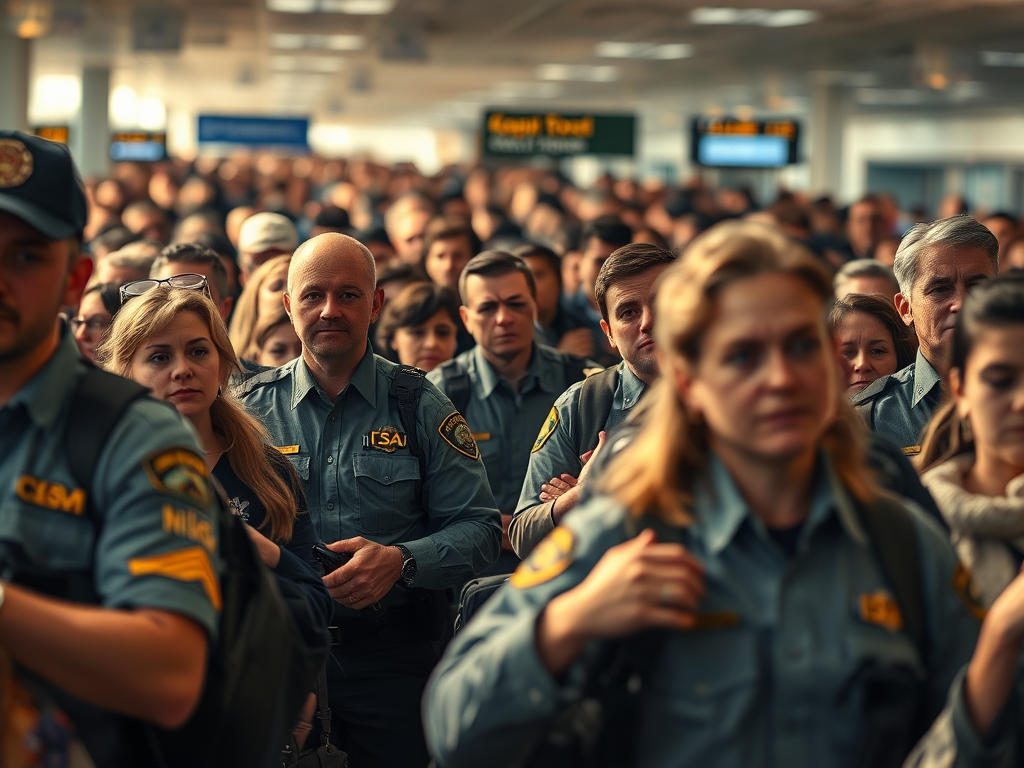
When Politics Breaks the Airport: The DHS Shutdown, Unpaid TSA Workers, and the Dangerous Normalization of Travel Chaos

Over the past several weeks, the United States has once again offered the world a strikingly self-inflicted lesson in institutional fragility. What should have been a routine spring travel period turned into a vivid demonstration of how quickly a modern transport system can unravel when political actors treat critical public infrastructure as leverage rather than as a national obligation. The Department of Homeland Security shutdown, and the resulting decision to leave Transportation Security Administration personnel unpaid, has done far more than generate operational inconvenience. It has exposed a deep structural weakness in the American model of governance, a dangerous tolerance for dysfunction, and an alarming willingness on both sides of the political aisle to instrumentalize frontline workers and traveling citizens in a broader partisan confrontation.

This is not merely a story about airport lines. It is a story about governance credibility, labor dignity, operational resilience, and the basic obligations of a serious economy. Airports are not symbolic assets. They are part of the country’s commercial bloodstream. When airport security becomes unstable, the consequences cascade quickly: passenger delays, missed connections, operational disruption for airlines, reputational damage for airports, financial hardship for workers, and reduced confidence in the reliability of the national transport system. To allow that instability to fester for political signaling is not strategy. It is negligence.

What has made this episode especially troubling is that the dysfunction was not hidden. It was visible, measurable, and entirely predictable. TSA officers were asked to continue reporting to work without pay. Attrition rose. Call-outs surged. Passenger wait times expanded dramatically in several major airports. Smaller airports began to look particularly vulnerable. Meanwhile, elected leaders continued treating the standoff as a contest of narrative positioning rather than as an urgent operational crisis requiring immediate resolution.

In that context, one of the more striking reactions came not from Washington, but from the airline industry itself. Delta Air Lines, under Ed Bastian’s leadership, chose to suspend special travel services previously extended to members of Congress. That decision mattered far beyond its immediate operational scope. It represented an unusually clear corporate statement: if lawmakers are prepared to tolerate disruption for everyone else, they should not expect to be insulated from its consequences. It was a rare example of executive accountability being asserted from outside government, and it resonated because it reflected a principle many travelers and workers already understood intuitively: privilege cannot continue uninterrupted while the system supporting ordinary passengers is being starved.

The Real Problem Was Never Just the Shutdown Itself

Government shutdowns in the United States have become so recurrent that they are often discussed as if they were unfortunate but normal features of the political landscape. That normalization is itself part of the problem. A shutdown affecting the Department of Homeland Security is not a routine budget event. It strikes directly at airport security, border operations, emergency preparedness, and the infrastructure of domestic mobility. Treating that as just another round in Washington’s procedural warfare fundamentally misunderstands the economic and operational centrality of DHS functions.

The TSA sits at the very heart of that exposure. Commercial aviation cannot operate at scale without reliable, adequately staffed, professionally managed checkpoint operations. Airlines can adjust schedules, airports can reconfigure passenger flows, and travelers can be urged to arrive earlier, but these are coping mechanisms, not solutions. The actual dependency remains the same: without enough trained people at checkpoints, the entire system begins to fail in ways that are highly visible and quickly contagious.

That is what made the decision to leave TSA officers unpaid so indefensible. Security personnel are not optional labor. They are essential workers whose presence underpins the legal, operational, and psychological viability of air travel. Asking them to absorb prolonged financial hardship while simultaneously expecting flawless performance under public pressure is not only unfair; it is strategically absurd. No serious executive would design a workforce model this way. Yet that is effectively what the political system imposed on one of the country’s most visible frontline workforces.

Even more troubling, the consequences were foreseeable. Anyone with a basic understanding of labor economics and airport operations could have predicted rising absenteeism, resignations, morale collapse, and degraded passenger experience. Once employees miss paychecks, especially in a profession not characterized by extraordinary compensation, the impact is immediate. Rent, childcare, transportation, food, and debt obligations do not pause for political theater. When those workers begin stepping away from the checkpoint, the system does not fail abstractly. It fails in public, in real time, with thousands of witnesses and millions of dollars of downstream cost.

The Human Cost Was the First Failure

The first and most important point is often the one most quickly lost in institutional debates: unpaid TSA personnel were not a talking point. They were people. They were workers expected to continue ensuring the functioning of a national security and transport interface while their own financial stability deteriorated. That arrangement is morally questionable and operationally reckless.

There is a persistent tendency in U.S. political life to speak about essential workers in heroic language while managing them through disposable assumptions. The rhetoric emphasizes service, sacrifice, and patriotism. The lived reality, too often, is delayed pay, public abuse, rising stress, and indifference from decision-makers until the disruption becomes impossible to ignore. This latest shutdown fit that pattern perfectly.

For TSA officers, the issue was not only the absence of pay. It was the message encoded in that absence. It signaled that their labor was indispensable enough to be demanded but not respected enough to be protected. It told them that the system could continue asking for discipline, professionalism, and public-facing performance even while failing its most basic reciprocal obligation. Once a workforce internalizes that message, the damage exceeds the immediate crisis. Retention worsens. recruitment becomes harder. Cynicism deepens. Institutional trust erodes.

That is why this episode should concern anyone thinking beyond the next news cycle. Essential workforces cannot be sustainably managed through episodic coercion. If the United States wants resilient airport security, it needs a labor compact that reflects reality rather than convenience. Security cannot be treated as mission-critical one day and fiscally expendable the next. Workers notice the contradiction, and so does the market.

The Passenger Experience Was the Most Visible Symptom

Travelers experienced the shutdown not through budget language, but through chaos. Longer lines, uncertainty at checkpoints, airport advisories urging earlier arrival times, and growing anxiety about whether routine travel could still be relied upon all became part of the passenger experience. For business travelers, that meant lost time, reduced productivity, and greater trip friction. For leisure travelers, especially families traveling during spring break periods, it meant added stress and a diminished sense of control. For airlines and airports, it meant operational noise injected into an already complex system.

The modern air travel chain is a tightly coordinated sequence. Schedule integrity, staffing models, baggage processing, gate management, customer service, crew legality, aircraft rotations, and connection flows are all interconnected. Security checkpoints are one of the most visible and least flexible parts of that chain. Once they become unstable, every downstream actor inherits the disruption. Planes may still depart, but the customer journey deteriorates sharply, and the reputational damage spreads far beyond the original cause.

This is where the political discourse often becomes disingenuous. Policymakers tend to describe such episodes as temporary inconvenience. That language systematically understates the cumulative cost. A major airport delay is not a minor consumer annoyance. It can mean missed client meetings, disrupted family events, additional hotel costs, missed cruise departures, lost onward international connections, and reduced confidence in domestic travel planning. In aggregate, these consequences carry real economic weight.

There is also a broader demand effect. When travelers perceive the system as unreliable, some discretionary trips are delayed or canceled. Corporate travel managers build in larger buffers. Travelers shift behavior toward perceived lower-risk options. The result is not a collapse in aviation demand overnight, but a reduction in system efficiency and customer confidence that weakens overall travel performance.

The Business Consequences Extended Far Beyond the Checkpoint

One of the persistent weaknesses in public debate around shutdowns is the failure to discuss them in management terms. If a private company knowingly deprived a mission-critical frontline workforce of pay, accepted rising absenteeism, watched service quality deteriorate, and then insisted that the customer impact was manageable, markets would punish it brutally. Yet in government, the same pattern is often framed as normal bargaining friction.

For airlines, the shutdown imposed real costs. Operational planning had to adjust around uncertain checkpoint throughput. Customer service teams had to absorb frustration for a problem they did not create. Irregular operations risk increased as travelers missed check-in windows or arrived at gates late. Brand perception became exposed to an externality outside airline control. Even when carriers were not directly responsible, they still occupied the front line of customer disappointment.

Airports faced similar pressure. Airport operators can optimize queue management, revise signage, increase communication, and coordinate with carriers, but they cannot replace federal security staffing. That makes them highly exposed to the reputational consequences of a system they do not fully control. In practical terms, passengers do not always distinguish between airline failure, airport failure, and government failure. They remember only that their travel day went badly.

The wider travel ecosystem also absorbs the shock. Hotels see more distressed arrivals and no-shows. ground transportation providers must cope with fluctuating demand peaks. Meeting schedules are disrupted. Event attendance becomes less reliable. Corporate travel budgets absorb hidden inefficiencies. The notion that a DHS shutdown is somehow compartmentalized within Washington finance politics is simply false. It is transmitted directly into the real economy.

There is also a serious competitiveness issue. The United States already presents a paradox in travel: it remains one of the world’s most important aviation markets, but the traveler experience often suffers from aging infrastructure, fragmented operational ownership, and avoidable policy volatility. Each episode like this reinforces a perception of unreliability. For a country that depends heavily on business mobility, tourism, and global connectivity, that is not a trivial reputational problem.

The Weaponization of Essential Services by Both Parties Is Unacceptable

The most uncomfortable but necessary conclusion is that both Republicans and Democrats deserve criticism for allowing this situation to become a mechanism of leverage. The exact legislative arguments differ. The rhetorical framing differs. The constituency management differs. But the operational outcome was the same: essential airport security personnel were left in the middle of a partisan struggle, and travelers became collateral damage.

Republicans cannot credibly position themselves as champions of order, security, and economic normalcy while tolerating a prolonged state in which airport security workers go unpaid and checkpoint performance deteriorates. If an issue is truly critical to public safety and economic continuity, it should be funded and insulated with urgency. To do otherwise is to turn one’s own stated priorities into bargaining chips.

Democrats, meanwhile, cannot credibly claim to defend workers while accepting a strategy that leaves frontline federal personnel without pay in the name of broader policy objectives. Even when the underlying substantive disagreements may be serious, the chosen mechanism matters. Once the tactic involves prolonged harm to essential workers and public-facing disruption, it becomes difficult to maintain the moral high ground.

This is where the political class often loses touch with institutional responsibility. There is a difference between taking a hard negotiating position and weaponizing the functioning of basic national systems. Airport security, like air traffic management, emergency response, or core public health operations, should sit on the protected side of that line. Once both parties become comfortable crossing it, the country drifts into a permanently unstable operating model where essential continuity depends on political mood rather than governance discipline.

That is not democratic toughness. It is institutional immaturity.

Why Ed Bastian and Delta Got This Mostly Right

Against that backdrop, Delta’s decision to suspend special services for members of Congress stood out because it carried symbolic precision. It did not amount to grandstanding without cost. It connected the privileges of political decision-makers to the consequences of the crisis they had allowed to continue. That linkage matters.

Ed Bastian has often positioned himself not only as the leader of a major airline, but as an executive willing to speak directly about system-level issues affecting travel. In this case, Delta’s response did something rare in corporate America: it moved beyond generic statements of concern and imposed a modest but meaningful accountability mechanism on a political class that is often insulated from the operational pain it creates.

The decision was strategically smart for several reasons. First, it aligned Delta with public frustration and worker reality rather than elite privilege. Second, it reinforced the airline’s brand as one prepared to defend operational integrity. Third, it signaled that travel companies need not quietly absorb political dysfunction while continuing to facilitate special treatment for the very people enabling it.

Importantly, this was not an anti-government gesture. It was a pro-accountability one. Members of Congress were not denied travel. They were simply told, in effect, that while frontline workers and ordinary passengers were enduring the consequences of Washington’s failure, they would no longer enjoy a parallel universe of convenience. That is an entirely defensible position.

More airline leaders should be willing to articulate similar clarity. The industry has every right to demand that essential aviation and security functions be protected from future shutdown politics. When airlines are expected to maintain reliability while the federal government undermines one of the foundations of that reliability, silence becomes a form of passive acceptance.

The Industry Response Showed a More Serious Understanding of Risk Than Washington Did

One of the more revealing aspects of this episode was that airline executives often appeared to understand the stakes more clearly than elected officials. From an airline management perspective, the situation was obviously untenable. A critical operational dependency was degrading in real time. Customer trust was at risk. Airport throughput was becoming uncertain. Media narratives were shifting from inconvenience to institutional breakdown. Any competent executive reading those signals would escalate immediately.

That is precisely why the response from aviation leaders carried weight. Their message was not ideological. It was operational. Pay the workers. End the standoff. Stop turning airport security into a political football. That is not partisan analysis. It is business realism.

The contrast with Washington was stark. Too many political actors behaved as though the crisis remained abstract until complete airport paralysis occurred. That is a remarkably poor threshold for action. Good management intervenes before the full-blown failure state. It does not wait until the queue is wrapping through terminals and public confidence is visibly cracking.

This difference in posture should be studied carefully. It suggests that industry leaders, despite their own incentives and limitations, may now be more attuned than policymakers to the fragility of the travel system. That is not necessarily because they are more virtuous. It is because they are closer to the real operating consequences. They see how thin the margin can become between a strained system and a broken one.

The Substitution Logic Was a Warning Sign

One of the more disturbing dimensions of the crisis was the apparent comfort with stopgap substitution logic: if enough TSA workers are absent, perhaps other federal personnel can be deployed to fill pieces of the gap. Whatever tactical rationale may be offered in the moment, that instinct should worry anyone concerned with institutional integrity.

Modern security systems depend not only on bodies in space, but on training, role clarity, procedural rigor, and professional legitimacy. The idea that one can casually patch over a security workforce crisis through improvised redeployment reflects a dangerously shallow understanding of operational specialization. It also sends a damaging signal to the affected workforce: your expertise is treated as interchangeable right up until it is urgently needed.

Even if temporary support measures are operationally necessary in a crisis, they do not solve the underlying problem. They merely mask it. And when masking becomes politically convenient, resolution gets delayed. That is exactly what should not happen in a function as visible and consequential as airport security.

The deeper lesson is simple: resilience is not the same as improvisation. A resilient system has protected funding, credible staffing pipelines, strong retention, and clear continuity protocols. An improvisational system lurches from crisis to workaround and congratulates itself for not completely collapsing. The United States should aspire to the former, but too often settles for the latter.

What This Reveals About the American State Capacity Problem

This travel disruption is not an isolated policy embarrassment. It is one expression of a broader state capacity problem. The U.S. remains capable of enormous scale, extraordinary innovation, and deep institutional reach. Yet it repeatedly demonstrates an inability to protect core functions from predictable political self-sabotage. That contradiction is increasingly central to the lived experience of citizens and businesses alike.

In practical terms, state capacity is not measured by the number of agencies or the volume of public spending. It is measured by whether a system can perform essential functions reliably under pressure. Can it keep airports functioning during a political dispute? Can it protect frontline workers from becoming bargaining instruments? Can it sustain public confidence in basic continuity? During this episode, the answer was plainly unsatisfactory.

This matters for more than travel. Once a government repeatedly shows that essential functions may be destabilized by partisan brinkmanship, every dependent sector begins pricing in dysfunction. Companies build workarounds. Citizens lower expectations. Workers disengage. The long-term result is not merely frustration. It is a decline in institutional ambition. People stop expecting competence and start optimizing around its absence.

That is one of the most corrosive effects of repeated shutdown politics. It teaches society to normalize poor governance rather than to demand better governance. And in sectors like travel, where coordination and trust are foundational, that normalization carries significant economic and reputational cost.

What a Serious Reform Agenda Would Look Like

If policymakers and industry leaders genuinely want to learn from this episode, the response cannot be limited to reopening government and moving on. The system needs structural reform that prevents essential travel security from being used this way again.

First, compensation continuity for essential security personnel should be automatic. No TSA officer, air traffic-related employee, or similarly critical operational worker should ever face unpaid status because of a congressional impasse. The legal and fiscal architecture should make that impossible.

Second, DHS operational continuity rules should be tightened for travel-critical functions. If the country accepts that aviation security is indispensable, then its funding protection should reflect that status. Essentiality must mean more than rhetorical importance.

Third, Congress should face stronger direct consequences when it allows these disruptions to continue. Delta’s symbolic move was effective precisely because it touched comfort and privilege. Institutional reform should explore similar logic more formally. If lawmakers can permit system failure while remaining insulated from it, incentives remain badly misaligned.

Fourth, the aviation industry should use this moment to push for a broader resilience compact with government. Airlines, airports, airport labor representatives, and federal agencies should define clearer escalation protocols and public transparency standards for security staffing crises. Better foresight will not eliminate political dysfunction, but it can reduce the degree to which passengers and workers are left in the dark.

Finally, public debate must become more adult. It is possible to hold strong positions on immigration, border enforcement, labor rights, or executive power without taking airport security workers hostage in the process. A mature political system knows how to separate substantive conflict from operational destruction. The U.S. political class too often behaves as though it does not.

The Bigger Strategic Lesson for Business Leaders

There is also a broader lesson here for private-sector executives far beyond aviation. The DHS shutdown demonstrates that political risk in the United States can no longer be treated as a distant regulatory variable. It now has immediate operating consequences in customer experience, workforce stability, logistics, and reputation. That means leaders in travel, hospitality, retail, events, and any business dependent on mobility must upgrade how they think about public-sector fragility.

In the past, many companies assumed that basic federal continuity would hold even amid partisan noise. That assumption is becoming harder to defend. Strategic planning now requires more explicit consideration of how political deadlock can impair frontline national infrastructure. This is not merely a public affairs issue. It is an enterprise resilience issue.

Executives should also recognize that moments like this create leadership tests. Customers, employees, and investors notice whether companies remain passive, issue bland statements, or speak with clarity. Delta’s move gained attention precisely because it reflected a clear point of view. In a period when institutions increasingly blur responsibility, there is reputational value in identifying where accountability actually belongs.

That does not mean every company should become performatively political. It means they should be willing to defend the operational and ethical foundations of their industries. For airlines, that includes insisting that airport security workers are paid. For hospitality companies, it may mean speaking about the economic consequences of transport instability. For business leaders more generally, it means understanding that silence is not always neutrality. Sometimes it is acquiescence to dysfunction.

Conclusion: The Airport Is a Mirror of the State

Airports are one of the clearest mirrors of state effectiveness. They are where policy, labor, infrastructure, security, technology, and public expectation meet in a highly compressed environment. When that system runs well, it signals competence. When it begins to crack under avoidable political pressure, it signals something more troubling: that the country is losing the ability to protect core functions from self-inflicted disruption.

The DHS shutdown and the unpaid status imposed on TSA workers were not just unfortunate byproducts of legislative disagreement. They were evidence of a deeper governance failure. Both Republicans and Democrats allowed essential personnel and ordinary travelers to become leverage points in a broader political contest. That is unacceptable on ethical grounds, indefensible on operational grounds, and costly on economic grounds.

At the same time, this episode also clarified where some of the stronger leadership came from. Airline executives, and particularly Ed Bastian, showed a greater willingness than many elected officials to name the absurdity of the situation and respond in a way that connected privilege to accountability. Suspending congressional perks did not solve the shutdown, but it made an important point: those who create public dysfunction should not be buffered from experiencing any of it.

The United States cannot continue managing essential travel infrastructure through a combination of worker sacrifice, passenger frustration, and political indifference. A serious country does not leave airport security officers unpaid while pretending the damage is temporary. A serious political class does not weaponize national mobility systems in pursuit of narrative advantage. And a serious reform agenda does not merely reopen the government; it ensures that the same failure cannot be repeated so easily.

The real issue is not whether this shutdown will eventually end. It will. The real issue is whether the country learns anything durable from it. If the answer is no, then the next crisis is already in preparation, and the next airport line is simply waiting for its turn.

Key Takeaways

  • The DHS shutdown turned airport security into a public example of governance failure, not merely a budget dispute.
  • Leaving TSA officers unpaid was both ethically indefensible and operationally reckless.
  • Travel disruption rapidly spread beyond checkpoints into airline operations, airport reputation, business travel efficiency, and the broader travel economy.
  • Both Republicans and Democrats bear responsibility for weaponizing essential public services as leverage.
  • Delta and Ed Bastian were right to suspend special congressional travel services and make accountability more tangible.
  • The deeper issue is state capacity: a serious economy cannot repeatedly allow critical mobility infrastructure to be destabilized by partisan brinkmanship.
  • The long-term answer is structural reform, including automatic pay continuity for essential aviation-security personnel and stronger protections for travel-critical operations.

Iran’s Shockwave Through the Sky: How the New Middle East Conflict Is Repricing Airline Risk and Rewiring Oil Markets

The escalation of the Iran conflict has quickly become more than a regional geopolitical crisis. It is now a stress test for two industries that are structurally intertwined: aviation and energy. Airlines run on oil, global trade depends on stable air corridors, and investor confidence in both sectors is built on one fundamental assumption — that major chokepoints in energy and airspace will remain open enough for the system to function. That assumption has been badly shaken over the past days.

The market reaction has been swift and brutal. Brent crude surged sharply, airline equities sold off across regions, and the financial logic is straightforward: when oil spikes, jet fuel tends to move even more aggressively; when airspace closes, routes lengthen; when both happen at once, airline unit economics deteriorate fast.

For the airline sector, this is not a single-variable shock. It is a compound disruption. Carriers are simultaneously facing higher fuel costs, longer routings, sudden capacity dislocations, flight suspensions across multiple destinations, and a likely demand response if fares remain elevated. For oil markets, the conflict revives the oldest fear in the book: the risk that instability around Iran turns the Strait of Hormuz from a geopolitical concern into a sustained supply bottleneck.

What makes this moment particularly significant is that it collides with an industry narrative that had been relatively constructive going into 2026. Airlines had been expecting a more benign fuel environment this year. That outlook has now been abruptly challenged. The industry entered 2026 expecting some relief; instead, it may be walking into another margin squeeze.

Aviation’s Immediate Problem: Fuel Cost Inflation Arrives Faster Than Revenue Can Adjust

Fuel is not the largest cost line for every airline anymore, but it remains one of the most volatile and strategically dangerous. Airline planning, guidance, route economics, and pricing strategies were built on a relatively manageable cost environment. A sudden oil shock destabilizes all of that at once.

And the pass-through is not immediate. Many airlines sold their tickets weeks or months ago, meaning the current surge in fuel costs cannot simply be billed back to customers overnight. This is why even a short-lived spike can distort quarterly results.

This is also why airline stocks reacted so violently. Investors are discounting the near-term reality that costs rise instantly while pricing catches up only gradually. That gap compresses margins. It also explains why markets punished carriers in different geographies at once: the exposure is global, not local.

In normal market conditions, airlines can offset part of this pressure through yield management, ancillary revenues, or network optimization. But a geopolitical airspace shock is different. It hits the cost base and the network simultaneously. Airlines are not just paying more for fuel; they are burning more of it.

Airspace Disruption Changes the Entire Network Equation

The conflict has also reminded the market how dependent long-haul aviation remains on stable overflight rights and predictable corridor access. As safety agencies and airlines adjust their operating recommendations, the practical result is the same: disruption becomes institutionalized for carriers serving Europe-Asia, Gulf long-haul flows, and several Middle Eastern destinations.

This is no longer a localized operational inconvenience. It is a broad network event. Airlines have been forced to reroute flights, carry extra fuel, and in some cases make additional refuelling stops to preserve resilience in case of sudden diversions. Each one of these measures increases cost, complexity, and schedule fragility.

The impact is especially acute because Gulf carriers are not niche players in the global aviation system. They represent a major share of traffic flows between Europe and Asia, as well as Europe and Oceania. When those connectors are disrupted, the shock ripples through the entire long-haul ecosystem, not just the Middle East.

Airlines across the world have already begun adjusting their schedules. Suspensions and cancellations have affected routes to and from multiple cities across the region. This breadth matters. It shows that the conflict is not just suppressing one or two routes; it is fracturing a commercially critical geography.

Why Long-Haul Airlines Are Especially Exposed

The current crisis is asymmetric. Not every carrier is equally vulnerable. Short-haul domestic operators in more protected fuel environments will feel the pain, but airlines with large long-haul exposure between Europe, Asia, and Oceania are on the front line. Their business models depend heavily on efficient routing, reliable widebody utilization, and premium traffic flows that do not respond well to operational uncertainty.

Longer routes also mean more than extra fuel. They can reduce aircraft productivity, disrupt crew legality windows, increase maintenance strain, and complicate recovery after even small delays. A routing extension on one sector can cascade into missed onward connections, aircraft mispositioning, and soft product degradation.

In premium aviation, those operational consequences can be as damaging to brand equity as the direct cost impact. This is precisely why network shocks of this type tend to show up not only in financial results, but also in customer sentiment.

There is also a demand-side risk. When airfares spike sharply because of scarcity and disruption, some leisure demand disappears and some corporate demand is deferred or more tightly controlled. If disruption persists, this could weigh on travel demand for much of 2026.

The Hedge Divide: Some Airlines Are Better Protected Than Others

One of the most important fault lines exposed by the crisis is the divergence in airline fuel hedging strategy. Some U.S. airlines have largely abandoned hedging over the past two decades, while a number of major Asian and European carriers still maintain meaningful protection. In a low or declining fuel environment, not hedging can look smart. In a geopolitical spike, it leaves airlines fully exposed to spot-market pain.

This is where treasury discipline suddenly becomes strategic. Airlines with stronger hedge positions are not immune to the crisis, but they are often better protected from the first wave of commodity shock. That buys time, protects short-term guidance, and gives management more room to respond operationally.

That said, hedging is not a universal shield. If the conflict persists long enough, airlines eventually roll into higher market levels. Hedges buy time more than immunity. They smooth the first wave; they do not neutralize a structurally higher fuel regime.

As a result, even better-protected carriers may still revise guidance, moderate capacity growth, or reprice aggressively if disruption lasts beyond the near term. The issue is not whether airlines can survive a short shock, but whether they are built to operate in a more volatile and politically fragmented world.

Oil Markets: Why Iran Still Matters Disproportionately

The reason markets react so violently to conflict involving Iran is not only about Iran’s own barrels. It is about geography. The Strait of Hormuz remains one of the most consequential energy chokepoints in the world. A large share of global seaborne oil trade and a meaningful share of LNG flows transit through that corridor.

That means the market is not merely pricing today’s lost barrels. It is pricing the risk to the corridor itself. Even if total supply destruction proves smaller than feared, the embedded risk premium can remain substantial as long as traders worry about shipping disruption, insurance costs, rerouting, or temporary outages among Gulf exporters and refiners.

There are partial mitigants. Some Gulf producers have pipeline infrastructure capable of bypassing part of Hormuz flows. But that capacity is limited relative to the scale of the corridor. Alternative routes can soften the shock; they cannot fully absorb it.

Markets understand that, which is why price responses can become nonlinear once Hormuz risk is perceived as more than theoretical. Once that happens, airlines are no longer reacting to headlines alone; they are reacting to a changed commodity environment.

From Deflation Story to Inflation Shock

Before this escalation, the macro oil story for 2026 had been relatively manageable, with expectations of softer balances and a less aggressive price environment. That base case has not disappeared, but it has been interrupted by geopolitics in a way that matters enormously for sentiment, inflation expectations, and sector valuation.

This is an important nuance. The market may ultimately discover that a geopolitical spike can coexist with a softer medium-term structural balance if the conflict stabilizes. But for airlines, the distinction is almost academic in the short term. They buy fuel in the market that exists today, not the one economists expected three months ago.

The damage to guidance, unit costs, and investor confidence can happen long before any reversion story plays out. This is why the aviation sector reacts so quickly to geopolitical oil shocks, even when the underlying commodity outlook remains debated.

There is a broader macro consequence as well. Oil shocks feed through into transportation costs, inflation expectations, consumer confidence, and corporate travel behavior. When fuel, logistics, and uncertainty all rise together, the pressure is not isolated to airlines. It spreads into tourism, cargo, retail supply chains, and business travel budgets.

What This Means for Airline Strategy in the Months Ahead

The most important strategic question is not whether airlines can absorb a few bad weeks. Most can. The real question is whether the crisis becomes a prolonged new operating environment. If it does, carriers will need to make harder choices on capacity, schedule design, fleet deployment, and pricing.

Three responses are already becoming visible. First, capacity is being reallocated. Airlines are moving aircraft away from suspended or commercially weakened destinations toward markets where demand remains more stable and yields can still hold.

Second, hedging and treasury strategy will return to the boardroom. Carriers that reduced or abandoned fuel hedging may reconsider how much pure commodity exposure they are willing to carry in a world of persistent geopolitical volatility.

Third, premium demand assumptions may need to be revisited. Corporates tolerate high fares during brief disruptions, but sustained uncertainty often leads to tighter travel approvals, more virtual substitution, and pressure on airline premium mix. For network carriers built around premium long-haul economics, that is as serious a warning sign as the fuel spike itself.

The Investor View: This Is Really a Margin Story

For equity markets, the immediate issue is not headline revenue. It is margin compression. Airlines entered 2026 with thin net margins by most industry standards even in a constructive scenario. In that context, a sharp fuel shock does not need to last forever to do meaningful damage.

A business running on structurally thin margins is highly sensitive to any rapid increase in variable cost. This is why the selloff should not be dismissed as market overreaction. Investors are repricing a business model whose profitability depends on cost stability more than many executives like to admit.

In aviation, a margin that looks acceptable in a steady state can unravel fast under stress. The sector’s operating leverage works both ways. This moment is a reminder that airlines are still, at their core, macro-sensitive, fuel-sensitive, and geopolitically exposed businesses.

A Broader Industry Lesson: Resilience Is No Longer Optional

There is also a more structural lesson here for the aviation sector. The past few years have forced airlines to manage pandemics, supply-chain breakdowns, engine issues, labor shortages, ATC constraints, and persistent geopolitical closures. The Iran conflict adds another layer to a growing pattern: shocks are no longer rare interruptions of normal business. They are becoming part of the operating model.

That changes what good management looks like. It is no longer just about maximizing load factor and squeezing cost in normal conditions. It is about building enough resilience into fleets, balance sheets, fuel strategy, crew planning, and network architecture to survive repeated discontinuities.

Carriers that optimize only for peacetime efficiency may continue to deliver attractive short-term numbers, but they will be punished whenever the system fractures. The current divergence between hedged and unhedged airlines is only one example of that principle.

Conclusion: The Iran Conflict Has Repriced More Than Oil

The immediate headline is easy to see: oil is up, airline shares are down, and routes across the Middle East are disrupted. But the deeper story is more important. The conflict has abruptly repriced risk across the aviation value chain. It has exposed how fragile long-haul network assumptions remain, how dependent airline profitability still is on energy stability, and how quickly a geopolitical event can turn into a commercial and financial one.

For oil markets, the central variable remains whether disruption around Iran and Hormuz becomes prolonged enough to harden the risk premium into a sustained supply shock. For airlines, the judgment is even starker: every additional week of elevated fuel prices and restricted airspace increases the probability of weaker margins, tighter schedules, and softer discretionary demand.

In other words, this is not just a Middle East story. It is a global aviation and macroeconomic story. Airlines were hoping for a more stable 2026. Instead, they have been reminded that in this industry, peace is not just a political condition. It is an operating assumption embedded in every fare, every route, and every quarterly forecast.


Key Takeaways

  • The Iran conflict has triggered a simultaneous airline cost shock and network shock, with fuel prices rising while airspace constraints lengthen routings and force cancellations.
  • Airline margins are under direct pressure because fuel costs rise immediately while pricing adjusts more slowly.
  • Long-haul carriers are especially exposed because their business models depend on efficient routing, widebody utilization, and premium traffic flows.
  • Airlines with stronger fuel hedging are better positioned in the immediate term than fully exposed peers, but hedging only buys time.
  • The Strait of Hormuz remains the key oil-market transmission channel, making this conflict a global aviation and energy story, not just a regional one.

Travel Demand 2026: Resilient Globally, Uneven in North America — What Marriott’s FY2025 Results Reveal

Today’s Marriott FY2025 announcement is a useful “industry barometer” because Marriott sits across almost every chain scale and geography: luxury to select-service, business transient to leisure, global gateway cities to secondary markets. The headline is not “travel is collapsing.” The story is more nuanced—and more strategic:

  • Worldwide demand is still resilient (especially cross-border), but it softened toward year-end in several markets.
  • North America is becoming K-shaped: premium holds up; value-oriented demand is more fragile.
  • Pricing power is increasingly segmented: luxury and experience-led destinations outperform while select-service faces pressure.
  • 2026 is shaping up as a “moderation year”: lower growth, higher dispersion, and sharper execution requirements.

This article breaks down the current state of travel/hotel demand worldwide with a focus on North America—using Marriott’s FY2025 results as the starting point, and then zooming out to what the data implies for operators, investors, destinations, and travelers.


1) The global picture: travel demand is still structurally strong

Globally, the travel engine is still running. International tourism continued to grow in 2025, supported by improved air connectivity, the continued rebound of Asia-Pacific destinations, and ongoing appetite for experiences—even with inflation in tourism services and a challenging geopolitical backdrop.

Two macro signals matter here:

  • Cross-border travel remains the “growth flywheel”, particularly for gateway cities and resort corridors that benefit from long-haul and premium leisure.
  • Spending is increasingly “value-optimized”: travelers still travel, but they trade off (length of stay, booking window, destination choice, and product tier) more actively than in the post-pandemic rebound surge.

Strategic takeaway: Global demand is not falling off a cliff. But “easy growth” is over. The industry is moving from rebound mode to competitive allocation mode: which segments, channels, and destinations win the next marginal traveler?

Sunlit hotel lobby with guests
Global travel is still “on”, but the demand mix is changing—fast. (Image: Unsplash)

2) Marriott’s FY2025 results: strong platform, uneven demand mix

Marriott’s FY2025 release confirms the pattern many operators have been feeling on the ground: growth exists, but it is increasingly uneven by region and chain scale.

Key read-across from Marriott’s announcement

  • Full year 2025: worldwide RevPAR increased ~2%, and net rooms grew ~4.3%, illustrating continued expansion of branded supply and the strength of the fee-based model.
  • Q4 2025: worldwide RevPAR rose ~1.9%, with international RevPAR up ~6% while U.S. & Canada were roughly flat.
  • Luxury outperformed (RevPAR up ~6%+), while performance moderated down the chain scales—a polite way to describe softness in more price-sensitive segments.
  • Development remained a growth engine: a global pipeline near ~610k rooms reinforces that owners still value the distribution + loyalty stack.

What makes Marriott especially useful as a lens is that their portfolio spans the “travel income distribution.” When Marriott says luxury is outperforming and select-service is under pressure, they are effectively describing a consumption reality: high-income travel demand is intact; lower- and middle-income demand is more constrained.


3) North America: travel demand is not weak — it’s fragmented

In North America, the best way to describe travel/hotel demand right now is: fragmented.

A K-shaped travel economy is showing up in hotels

North America is increasingly a tale of two travelers:

  • Affluent leisure continues to buy premium experiences (luxury resorts, iconic urban luxury, “special trips”), supporting ADR and premium upsell.
  • Budget-conscious travelers are more elastic: they shorten trips, shift dates, drive instead of fly, choose lower tiers, or delay discretionary travel.

Marriott’s own mix commentary reflects this: select-service in the U.S. saw declines while luxury grew, pointing to a widening performance gap across chain scales.

Business travel: stable, but cautious and “optimized”

Business travel in North America is not disappearing, but it is structurally more scrutinized than pre-2020:

  • More trip approval discipline; fewer “nice-to-have” trips
  • Shorter stays; tighter meeting agendas; more shoulder-night optimization
  • Higher expectations of ROI (customer outcomes, deal velocity, project delivery)

When business travel softens, it does not uniformly hit all markets. It hits weekday urban cores more than destination leisure, and it hits midscale/select-service differently than upper-upscale/luxury.


4) The U.S. hotel demand baseline: “flat-ish” volume, pressure on occupancy, ADR doing the heavy lifting

Across the U.S., the industry’s recent pattern can be summarized as:

  • Room nights are not collapsing, but growth is harder.
  • Occupancy is under pressure in several markets (especially where supply and alternative lodging compete aggressively).
  • ADR remains the primary lever—but only where the product is differentiated enough to sustain price integrity.

This matters because it changes how hotels should run their revenue strategy:

  • In a rebound, “rate up, volume follows.”
  • In a moderated cycle, “rate integrity versus share capture” becomes a daily trade-off.

5) The shadow competitor: short-term rentals keep reshaping demand

Short-term rentals are no longer a niche. They are a mainstream substitute—and in many markets, they are absorbing a meaningful share of leisure demand that historically fed hotels.

This is not just a leisure story. It’s also about:

  • Space arbitrage (families and groups choosing kitchens / multi-bedroom options)
  • Length-of-stay economics (weekly rates, cleaning fee structures, “work-from-anywhere” patterns)
  • Location convenience (neighborhood travel vs. central business districts)

Strategic takeaway: Hotels that win against short-term rentals are not the cheapest. They are the ones that make the “hotel value proposition” undeniable: consistency, service recovery, loyalty value, and experience design.


6) International markets: the growth story Marriott is pointing to

Marriott’s international RevPAR outperformance highlights where demand is still expanding more cleanly:

  • Europe (EMEA): strong cross-border flows and high willingness-to-pay in key destinations
  • APEC: continuing recovery and renewed momentum in major travel corridors
  • Premium long-haul leisure: travelers who “saved up” for major trips keep supporting higher-tier products

The implication: global network effects matter again. Brands with broad footprints, loyalty ecosystems, and multi-market negotiating power with owners have a structural advantage in capturing cross-border demand.


7) A simple dashboard: what the industry is signaling right now

SignalWhat it suggestsWhy it matters
Luxury outperformingAffluent demand remains intactPricing power exists—but is concentrated at the top
Select-service softnessBudget-conscious travelers are trading down or reducing tripsPromotions and loyalty offers become essential, but risk rate dilution
International RevPAR strongerCross-border travel is still the growth leverGateway assets and global brands capture disproportionate upside
Business travel cautiousTrips are optimized, not eliminatedWeekday/urban performance depends on events and corporate confidence
Alternative lodging pressureHotels compete for leisure share more directlyProduct differentiation and experience design become core strategy

8) What this means for hotel operators: execution beats macro

If you operate hotels in North America right now, the winners are typically not those with the best “macro story.” They are those with the best execution system. Here are the playbooks that matter in a fragmented demand environment:

(A) Segment precision in revenue management

  • Stop treating “leisure” as one segment: separate affluent leisure, value leisure, group leisure, event-driven leisure.
  • Use more dynamic offer design: bundles (breakfast/parking), value-adds, and targeted fenced offers.
  • Protect rate integrity in premium tiers; use tactical value levers in lower tiers without breaking the long-term ADR curve.

(B) Loyalty economics as a demand stabilizer

  • In a moderated cycle, loyalty is not just marketing; it is demand insurance.
  • Use member-only rates strategically, but ensure you are not simply shifting OTA demand into discounted member demand.
  • Invest in on-property recognition: if the experience is flat, loyalty becomes a commodity.

(C) Operational excellence is now a commercial strategy

  • When pricing power tightens, service recovery and consistency protect review scores—and review scores protect conversion.
  • Labor pressures remain real; smart scheduling and productivity tooling matter.
  • Food & beverage is either a margin drag or a differentiation lever—rarely both. Be intentional.

9) What this means for owners and investors: dispersion is the opportunity

The biggest investment mistake in 2026 is to think in averages. A “low-growth” year can still produce excellent outcomes if you are positioned in the right micro-markets with the right product.

Where outperformance is more likely

  • Experience-led leisure destinations with sustained demand drivers
  • Gateway cities where cross-border travel is strong and event calendars are dense
  • Luxury and upper-upscale assets with defensible pricing power
  • Well-branded conversions where distribution + loyalty can quickly lift performance

Where risk is higher

  • Undifferentiated select-service corridors with heavy supply and price-sensitive demand
  • Markets reliant on a single corporate driver (especially where office recovery is weak)
  • Assets competing head-to-head with short-term rentals without a clear hotel advantage

10) What this means for travelers: expect “better deals” in the middle, not at the top

If you are booking travel in 2026, the market structure suggests a clear pattern:

  • Luxury will stay expensive in top destinations because affluent demand is still there.
  • Upper-midscale and upscale will be promotional in many markets—especially in shoulder periods and weekends in business-heavy cities.
  • Flexibility is a superpower: shifting dates by a few days can dramatically change pricing in a fragmented demand environment.

Practical traveler tactics:

  • Use loyalty programs for targeted value (breakfast, late checkout, upgrades), not just points.
  • For North American cities: watch weekends for deals in business-heavy downtowns.
  • For resort/leisure: book earlier for premium inventory; last-minute is less reliable.

11) The 2026 outlook: moderation + volatility + big events

Marriott’s guidance implies a “moderate growth” year ahead. That aligns with the broader reality:

  • Demand is stable, but not accelerating in North America.
  • International flows remain important—and can swing quickly with policy, sentiment, and connectivity.
  • Event-driven spikes (major sports, conventions, destination festivals) will matter more than ever for market-level results.

My view: 2026 will reward operators and brands that manage dispersion—by segment, by channel, by market, by week. The “average traveler” is no longer the center of gravity. The winners will be those who design offers and experiences for specific travelers—and do it repeatedly, with discipline.


Conclusion: Marriott is not warning about demand collapse—it’s warning about demand composition

Marriott’s FY2025 results are fundamentally a composition story:

  • Global travel continues to grow, but the post-rebound “everyone travels everywhere” dynamic has normalized.
  • North America is not weak; it is fragmented and more price-sensitive at the bottom of the income distribution.
  • Luxury and international travel are carrying the industry’s growth narrative.
  • In 2026, execution is the strategy: segmentation, loyalty economics, and operational consistency will separate winners from everyone else.

If you are a hotel operator: segment ruthlessly and protect rate integrity.
If you are an owner/investor: focus on micro-market fundamentals and brand-enabled demand engines.
If you are a traveler: look for value in the middle tiers and in date flexibility—don’t expect luxury to get cheaper.