
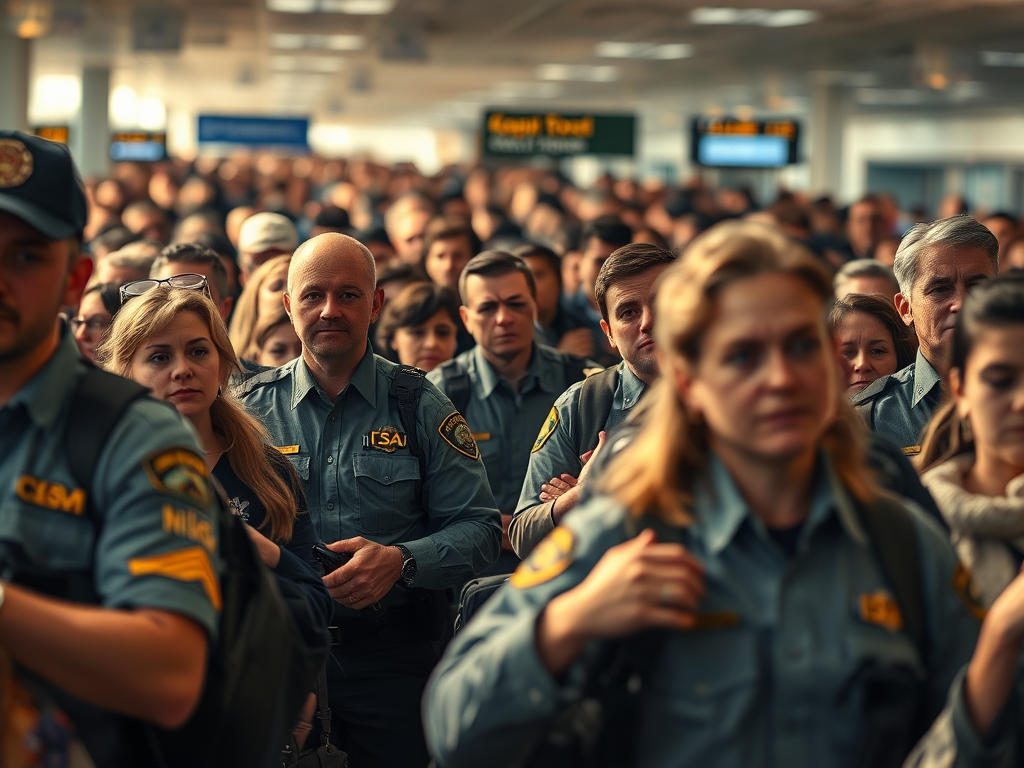
Over the past several weeks, the United States has once again offered the world a strikingly self-inflicted lesson in institutional fragility. What should have been a routine spring travel period turned into a vivid demonstration of how quickly a modern transport system can unravel when political actors treat critical public infrastructure as leverage rather than as a national obligation. The Department of Homeland Security shutdown, and the resulting decision to leave Transportation Security Administration personnel unpaid, has done far more than generate operational inconvenience. It has exposed a deep structural weakness in the American model of governance, a dangerous tolerance for dysfunction, and an alarming willingness on both sides of the political aisle to instrumentalize frontline workers and traveling citizens in a broader partisan confrontation.
This is not merely a story about airport lines. It is a story about governance credibility, labor dignity, operational resilience, and the basic obligations of a serious economy. Airports are not symbolic assets. They are part of the country’s commercial bloodstream. When airport security becomes unstable, the consequences cascade quickly: passenger delays, missed connections, operational disruption for airlines, reputational damage for airports, financial hardship for workers, and reduced confidence in the reliability of the national transport system. To allow that instability to fester for political signaling is not strategy. It is negligence.
What has made this episode especially troubling is that the dysfunction was not hidden. It was visible, measurable, and entirely predictable. TSA officers were asked to continue reporting to work without pay. Attrition rose. Call-outs surged. Passenger wait times expanded dramatically in several major airports. Smaller airports began to look particularly vulnerable. Meanwhile, elected leaders continued treating the standoff as a contest of narrative positioning rather than as an urgent operational crisis requiring immediate resolution.
In that context, one of the more striking reactions came not from Washington, but from the airline industry itself. Delta Air Lines, under Ed Bastian’s leadership, chose to suspend special travel services previously extended to members of Congress. That decision mattered far beyond its immediate operational scope. It represented an unusually clear corporate statement: if lawmakers are prepared to tolerate disruption for everyone else, they should not expect to be insulated from its consequences. It was a rare example of executive accountability being asserted from outside government, and it resonated because it reflected a principle many travelers and workers already understood intuitively: privilege cannot continue uninterrupted while the system supporting ordinary passengers is being starved.
The Real Problem Was Never Just the Shutdown Itself
Government shutdowns in the United States have become so recurrent that they are often discussed as if they were unfortunate but normal features of the political landscape. That normalization is itself part of the problem. A shutdown affecting the Department of Homeland Security is not a routine budget event. It strikes directly at airport security, border operations, emergency preparedness, and the infrastructure of domestic mobility. Treating that as just another round in Washington’s procedural warfare fundamentally misunderstands the economic and operational centrality of DHS functions.
The TSA sits at the very heart of that exposure. Commercial aviation cannot operate at scale without reliable, adequately staffed, professionally managed checkpoint operations. Airlines can adjust schedules, airports can reconfigure passenger flows, and travelers can be urged to arrive earlier, but these are coping mechanisms, not solutions. The actual dependency remains the same: without enough trained people at checkpoints, the entire system begins to fail in ways that are highly visible and quickly contagious.
That is what made the decision to leave TSA officers unpaid so indefensible. Security personnel are not optional labor. They are essential workers whose presence underpins the legal, operational, and psychological viability of air travel. Asking them to absorb prolonged financial hardship while simultaneously expecting flawless performance under public pressure is not only unfair; it is strategically absurd. No serious executive would design a workforce model this way. Yet that is effectively what the political system imposed on one of the country’s most visible frontline workforces.
Even more troubling, the consequences were foreseeable. Anyone with a basic understanding of labor economics and airport operations could have predicted rising absenteeism, resignations, morale collapse, and degraded passenger experience. Once employees miss paychecks, especially in a profession not characterized by extraordinary compensation, the impact is immediate. Rent, childcare, transportation, food, and debt obligations do not pause for political theater. When those workers begin stepping away from the checkpoint, the system does not fail abstractly. It fails in public, in real time, with thousands of witnesses and millions of dollars of downstream cost.
The Human Cost Was the First Failure
The first and most important point is often the one most quickly lost in institutional debates: unpaid TSA personnel were not a talking point. They were people. They were workers expected to continue ensuring the functioning of a national security and transport interface while their own financial stability deteriorated. That arrangement is morally questionable and operationally reckless.
There is a persistent tendency in U.S. political life to speak about essential workers in heroic language while managing them through disposable assumptions. The rhetoric emphasizes service, sacrifice, and patriotism. The lived reality, too often, is delayed pay, public abuse, rising stress, and indifference from decision-makers until the disruption becomes impossible to ignore. This latest shutdown fit that pattern perfectly.
For TSA officers, the issue was not only the absence of pay. It was the message encoded in that absence. It signaled that their labor was indispensable enough to be demanded but not respected enough to be protected. It told them that the system could continue asking for discipline, professionalism, and public-facing performance even while failing its most basic reciprocal obligation. Once a workforce internalizes that message, the damage exceeds the immediate crisis. Retention worsens. recruitment becomes harder. Cynicism deepens. Institutional trust erodes.
That is why this episode should concern anyone thinking beyond the next news cycle. Essential workforces cannot be sustainably managed through episodic coercion. If the United States wants resilient airport security, it needs a labor compact that reflects reality rather than convenience. Security cannot be treated as mission-critical one day and fiscally expendable the next. Workers notice the contradiction, and so does the market.
The Passenger Experience Was the Most Visible Symptom
Travelers experienced the shutdown not through budget language, but through chaos. Longer lines, uncertainty at checkpoints, airport advisories urging earlier arrival times, and growing anxiety about whether routine travel could still be relied upon all became part of the passenger experience. For business travelers, that meant lost time, reduced productivity, and greater trip friction. For leisure travelers, especially families traveling during spring break periods, it meant added stress and a diminished sense of control. For airlines and airports, it meant operational noise injected into an already complex system.
The modern air travel chain is a tightly coordinated sequence. Schedule integrity, staffing models, baggage processing, gate management, customer service, crew legality, aircraft rotations, and connection flows are all interconnected. Security checkpoints are one of the most visible and least flexible parts of that chain. Once they become unstable, every downstream actor inherits the disruption. Planes may still depart, but the customer journey deteriorates sharply, and the reputational damage spreads far beyond the original cause.
This is where the political discourse often becomes disingenuous. Policymakers tend to describe such episodes as temporary inconvenience. That language systematically understates the cumulative cost. A major airport delay is not a minor consumer annoyance. It can mean missed client meetings, disrupted family events, additional hotel costs, missed cruise departures, lost onward international connections, and reduced confidence in domestic travel planning. In aggregate, these consequences carry real economic weight.
There is also a broader demand effect. When travelers perceive the system as unreliable, some discretionary trips are delayed or canceled. Corporate travel managers build in larger buffers. Travelers shift behavior toward perceived lower-risk options. The result is not a collapse in aviation demand overnight, but a reduction in system efficiency and customer confidence that weakens overall travel performance.
The Business Consequences Extended Far Beyond the Checkpoint
One of the persistent weaknesses in public debate around shutdowns is the failure to discuss them in management terms. If a private company knowingly deprived a mission-critical frontline workforce of pay, accepted rising absenteeism, watched service quality deteriorate, and then insisted that the customer impact was manageable, markets would punish it brutally. Yet in government, the same pattern is often framed as normal bargaining friction.
For airlines, the shutdown imposed real costs. Operational planning had to adjust around uncertain checkpoint throughput. Customer service teams had to absorb frustration for a problem they did not create. Irregular operations risk increased as travelers missed check-in windows or arrived at gates late. Brand perception became exposed to an externality outside airline control. Even when carriers were not directly responsible, they still occupied the front line of customer disappointment.
Airports faced similar pressure. Airport operators can optimize queue management, revise signage, increase communication, and coordinate with carriers, but they cannot replace federal security staffing. That makes them highly exposed to the reputational consequences of a system they do not fully control. In practical terms, passengers do not always distinguish between airline failure, airport failure, and government failure. They remember only that their travel day went badly.
The wider travel ecosystem also absorbs the shock. Hotels see more distressed arrivals and no-shows. ground transportation providers must cope with fluctuating demand peaks. Meeting schedules are disrupted. Event attendance becomes less reliable. Corporate travel budgets absorb hidden inefficiencies. The notion that a DHS shutdown is somehow compartmentalized within Washington finance politics is simply false. It is transmitted directly into the real economy.
There is also a serious competitiveness issue. The United States already presents a paradox in travel: it remains one of the world’s most important aviation markets, but the traveler experience often suffers from aging infrastructure, fragmented operational ownership, and avoidable policy volatility. Each episode like this reinforces a perception of unreliability. For a country that depends heavily on business mobility, tourism, and global connectivity, that is not a trivial reputational problem.
The Weaponization of Essential Services by Both Parties Is Unacceptable
The most uncomfortable but necessary conclusion is that both Republicans and Democrats deserve criticism for allowing this situation to become a mechanism of leverage. The exact legislative arguments differ. The rhetorical framing differs. The constituency management differs. But the operational outcome was the same: essential airport security personnel were left in the middle of a partisan struggle, and travelers became collateral damage.
Republicans cannot credibly position themselves as champions of order, security, and economic normalcy while tolerating a prolonged state in which airport security workers go unpaid and checkpoint performance deteriorates. If an issue is truly critical to public safety and economic continuity, it should be funded and insulated with urgency. To do otherwise is to turn one’s own stated priorities into bargaining chips.
Democrats, meanwhile, cannot credibly claim to defend workers while accepting a strategy that leaves frontline federal personnel without pay in the name of broader policy objectives. Even when the underlying substantive disagreements may be serious, the chosen mechanism matters. Once the tactic involves prolonged harm to essential workers and public-facing disruption, it becomes difficult to maintain the moral high ground.
This is where the political class often loses touch with institutional responsibility. There is a difference between taking a hard negotiating position and weaponizing the functioning of basic national systems. Airport security, like air traffic management, emergency response, or core public health operations, should sit on the protected side of that line. Once both parties become comfortable crossing it, the country drifts into a permanently unstable operating model where essential continuity depends on political mood rather than governance discipline.
That is not democratic toughness. It is institutional immaturity.
Why Ed Bastian and Delta Got This Mostly Right
Against that backdrop, Delta’s decision to suspend special services for members of Congress stood out because it carried symbolic precision. It did not amount to grandstanding without cost. It connected the privileges of political decision-makers to the consequences of the crisis they had allowed to continue. That linkage matters.
Ed Bastian has often positioned himself not only as the leader of a major airline, but as an executive willing to speak directly about system-level issues affecting travel. In this case, Delta’s response did something rare in corporate America: it moved beyond generic statements of concern and imposed a modest but meaningful accountability mechanism on a political class that is often insulated from the operational pain it creates.
The decision was strategically smart for several reasons. First, it aligned Delta with public frustration and worker reality rather than elite privilege. Second, it reinforced the airline’s brand as one prepared to defend operational integrity. Third, it signaled that travel companies need not quietly absorb political dysfunction while continuing to facilitate special treatment for the very people enabling it.
Importantly, this was not an anti-government gesture. It was a pro-accountability one. Members of Congress were not denied travel. They were simply told, in effect, that while frontline workers and ordinary passengers were enduring the consequences of Washington’s failure, they would no longer enjoy a parallel universe of convenience. That is an entirely defensible position.
More airline leaders should be willing to articulate similar clarity. The industry has every right to demand that essential aviation and security functions be protected from future shutdown politics. When airlines are expected to maintain reliability while the federal government undermines one of the foundations of that reliability, silence becomes a form of passive acceptance.
The Industry Response Showed a More Serious Understanding of Risk Than Washington Did
One of the more revealing aspects of this episode was that airline executives often appeared to understand the stakes more clearly than elected officials. From an airline management perspective, the situation was obviously untenable. A critical operational dependency was degrading in real time. Customer trust was at risk. Airport throughput was becoming uncertain. Media narratives were shifting from inconvenience to institutional breakdown. Any competent executive reading those signals would escalate immediately.
That is precisely why the response from aviation leaders carried weight. Their message was not ideological. It was operational. Pay the workers. End the standoff. Stop turning airport security into a political football. That is not partisan analysis. It is business realism.
The contrast with Washington was stark. Too many political actors behaved as though the crisis remained abstract until complete airport paralysis occurred. That is a remarkably poor threshold for action. Good management intervenes before the full-blown failure state. It does not wait until the queue is wrapping through terminals and public confidence is visibly cracking.
This difference in posture should be studied carefully. It suggests that industry leaders, despite their own incentives and limitations, may now be more attuned than policymakers to the fragility of the travel system. That is not necessarily because they are more virtuous. It is because they are closer to the real operating consequences. They see how thin the margin can become between a strained system and a broken one.
The Substitution Logic Was a Warning Sign
One of the more disturbing dimensions of the crisis was the apparent comfort with stopgap substitution logic: if enough TSA workers are absent, perhaps other federal personnel can be deployed to fill pieces of the gap. Whatever tactical rationale may be offered in the moment, that instinct should worry anyone concerned with institutional integrity.
Modern security systems depend not only on bodies in space, but on training, role clarity, procedural rigor, and professional legitimacy. The idea that one can casually patch over a security workforce crisis through improvised redeployment reflects a dangerously shallow understanding of operational specialization. It also sends a damaging signal to the affected workforce: your expertise is treated as interchangeable right up until it is urgently needed.
Even if temporary support measures are operationally necessary in a crisis, they do not solve the underlying problem. They merely mask it. And when masking becomes politically convenient, resolution gets delayed. That is exactly what should not happen in a function as visible and consequential as airport security.
The deeper lesson is simple: resilience is not the same as improvisation. A resilient system has protected funding, credible staffing pipelines, strong retention, and clear continuity protocols. An improvisational system lurches from crisis to workaround and congratulates itself for not completely collapsing. The United States should aspire to the former, but too often settles for the latter.
What This Reveals About the American State Capacity Problem
This travel disruption is not an isolated policy embarrassment. It is one expression of a broader state capacity problem. The U.S. remains capable of enormous scale, extraordinary innovation, and deep institutional reach. Yet it repeatedly demonstrates an inability to protect core functions from predictable political self-sabotage. That contradiction is increasingly central to the lived experience of citizens and businesses alike.
In practical terms, state capacity is not measured by the number of agencies or the volume of public spending. It is measured by whether a system can perform essential functions reliably under pressure. Can it keep airports functioning during a political dispute? Can it protect frontline workers from becoming bargaining instruments? Can it sustain public confidence in basic continuity? During this episode, the answer was plainly unsatisfactory.
This matters for more than travel. Once a government repeatedly shows that essential functions may be destabilized by partisan brinkmanship, every dependent sector begins pricing in dysfunction. Companies build workarounds. Citizens lower expectations. Workers disengage. The long-term result is not merely frustration. It is a decline in institutional ambition. People stop expecting competence and start optimizing around its absence.
That is one of the most corrosive effects of repeated shutdown politics. It teaches society to normalize poor governance rather than to demand better governance. And in sectors like travel, where coordination and trust are foundational, that normalization carries significant economic and reputational cost.
What a Serious Reform Agenda Would Look Like
If policymakers and industry leaders genuinely want to learn from this episode, the response cannot be limited to reopening government and moving on. The system needs structural reform that prevents essential travel security from being used this way again.
First, compensation continuity for essential security personnel should be automatic. No TSA officer, air traffic-related employee, or similarly critical operational worker should ever face unpaid status because of a congressional impasse. The legal and fiscal architecture should make that impossible.
Second, DHS operational continuity rules should be tightened for travel-critical functions. If the country accepts that aviation security is indispensable, then its funding protection should reflect that status. Essentiality must mean more than rhetorical importance.
Third, Congress should face stronger direct consequences when it allows these disruptions to continue. Delta’s symbolic move was effective precisely because it touched comfort and privilege. Institutional reform should explore similar logic more formally. If lawmakers can permit system failure while remaining insulated from it, incentives remain badly misaligned.
Fourth, the aviation industry should use this moment to push for a broader resilience compact with government. Airlines, airports, airport labor representatives, and federal agencies should define clearer escalation protocols and public transparency standards for security staffing crises. Better foresight will not eliminate political dysfunction, but it can reduce the degree to which passengers and workers are left in the dark.
Finally, public debate must become more adult. It is possible to hold strong positions on immigration, border enforcement, labor rights, or executive power without taking airport security workers hostage in the process. A mature political system knows how to separate substantive conflict from operational destruction. The U.S. political class too often behaves as though it does not.
The Bigger Strategic Lesson for Business Leaders
There is also a broader lesson here for private-sector executives far beyond aviation. The DHS shutdown demonstrates that political risk in the United States can no longer be treated as a distant regulatory variable. It now has immediate operating consequences in customer experience, workforce stability, logistics, and reputation. That means leaders in travel, hospitality, retail, events, and any business dependent on mobility must upgrade how they think about public-sector fragility.
In the past, many companies assumed that basic federal continuity would hold even amid partisan noise. That assumption is becoming harder to defend. Strategic planning now requires more explicit consideration of how political deadlock can impair frontline national infrastructure. This is not merely a public affairs issue. It is an enterprise resilience issue.
Executives should also recognize that moments like this create leadership tests. Customers, employees, and investors notice whether companies remain passive, issue bland statements, or speak with clarity. Delta’s move gained attention precisely because it reflected a clear point of view. In a period when institutions increasingly blur responsibility, there is reputational value in identifying where accountability actually belongs.
That does not mean every company should become performatively political. It means they should be willing to defend the operational and ethical foundations of their industries. For airlines, that includes insisting that airport security workers are paid. For hospitality companies, it may mean speaking about the economic consequences of transport instability. For business leaders more generally, it means understanding that silence is not always neutrality. Sometimes it is acquiescence to dysfunction.
Conclusion: The Airport Is a Mirror of the State
Airports are one of the clearest mirrors of state effectiveness. They are where policy, labor, infrastructure, security, technology, and public expectation meet in a highly compressed environment. When that system runs well, it signals competence. When it begins to crack under avoidable political pressure, it signals something more troubling: that the country is losing the ability to protect core functions from self-inflicted disruption.
The DHS shutdown and the unpaid status imposed on TSA workers were not just unfortunate byproducts of legislative disagreement. They were evidence of a deeper governance failure. Both Republicans and Democrats allowed essential personnel and ordinary travelers to become leverage points in a broader political contest. That is unacceptable on ethical grounds, indefensible on operational grounds, and costly on economic grounds.
At the same time, this episode also clarified where some of the stronger leadership came from. Airline executives, and particularly Ed Bastian, showed a greater willingness than many elected officials to name the absurdity of the situation and respond in a way that connected privilege to accountability. Suspending congressional perks did not solve the shutdown, but it made an important point: those who create public dysfunction should not be buffered from experiencing any of it.
The United States cannot continue managing essential travel infrastructure through a combination of worker sacrifice, passenger frustration, and political indifference. A serious country does not leave airport security officers unpaid while pretending the damage is temporary. A serious political class does not weaponize national mobility systems in pursuit of narrative advantage. And a serious reform agenda does not merely reopen the government; it ensures that the same failure cannot be repeated so easily.
The real issue is not whether this shutdown will eventually end. It will. The real issue is whether the country learns anything durable from it. If the answer is no, then the next crisis is already in preparation, and the next airport line is simply waiting for its turn.
Key Takeaways
- The DHS shutdown turned airport security into a public example of governance failure, not merely a budget dispute.
- Leaving TSA officers unpaid was both ethically indefensible and operationally reckless.
- Travel disruption rapidly spread beyond checkpoints into airline operations, airport reputation, business travel efficiency, and the broader travel economy.
- Both Republicans and Democrats bear responsibility for weaponizing essential public services as leverage.
- Delta and Ed Bastian were right to suspend special congressional travel services and make accountability more tangible.
- The deeper issue is state capacity: a serious economy cannot repeatedly allow critical mobility infrastructure to be destabilized by partisan brinkmanship.
- The long-term answer is structural reform, including automatic pay continuity for essential aviation-security personnel and stronger protections for travel-critical operations.
