
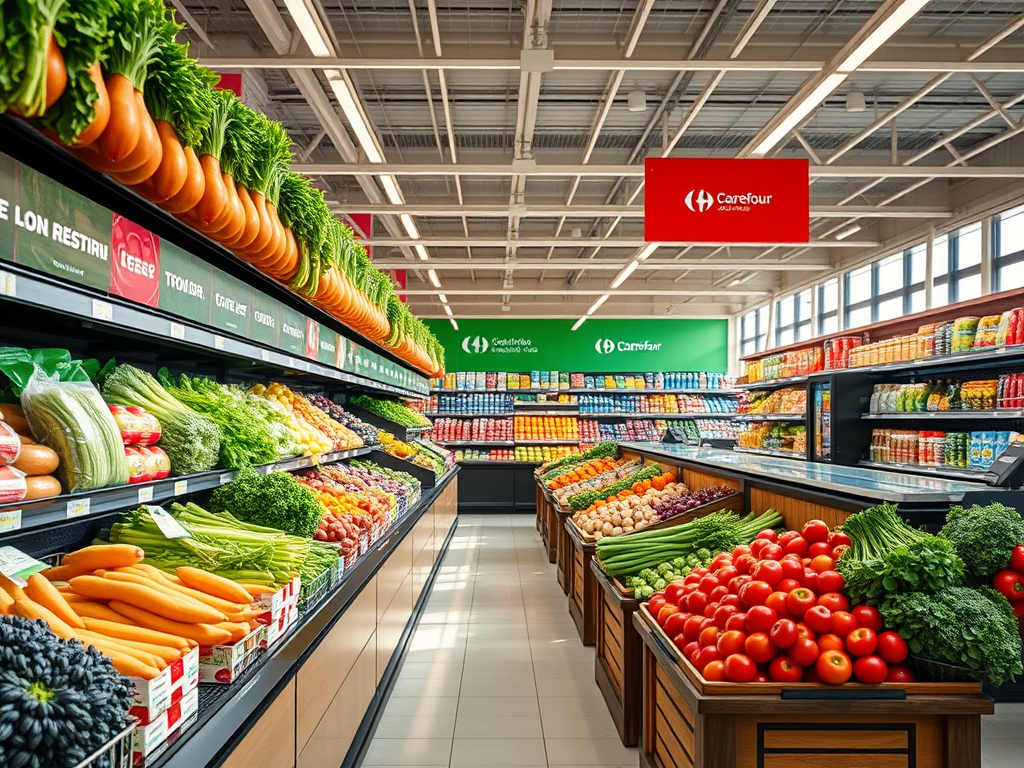
This week, Carrefour paired two messages that matter more together than separately: its FY 2025 results and the launch of “Carrefour 2030”, a multi-year plan positioned as a commercial and technology offensive.
At a time when retail is being squeezed between structurally value-driven consumers, shifting shopping missions, and relentless operating cost pressure, Carrefour’s plan is best read as a blueprint for how large retailers intend to compete through 2030: price credibility + fresh differentiation + loyalty as identity + automation at scale + new profit pools (media/data/services).
Executive summary
Carrefour 2030 makes three big bets:
- Win the customer through price competitiveness, fresh as the traffic engine, loyalty at scale (“Le Club”), and private label acceleration.
- Re-ignite store-led growth with targeted expansion (proximity, cash & carry) and a stronger asset-light/franchise operating model.
- Industrialize performance with AI + data + retail tech, including a “smart store” rollout and a bold move into agentic commerce with Google.
Carrefour also sets clear performance ambitions within the plan, including: €1.0bn annual cost savings by 2030, ROC margin of 3.2% in 2028 and 3.5% in 2030, and €5bn cumulative net free cash flow (2026–2028).
1) Why the timing matters: retail is entering the “post-shock” era
European retail is moving from an inflation shock environment into a new phase: consumers remain value-sensitive, but expectations for convenience, transparency, and quality have not gone down. At the same time, operating costs (labor, energy, logistics) stay elevated, and competition remains intense—especially in grocery where the discounters continue to set the floor on price perception.
In this environment, “publishing results” is no longer enough. Retailers are expected to answer, credibly and with measurable commitments:
- How do you protect price credibility without destroying margins?
- How do you keep large formats relevant and productive?
- How do you modernize stores at scale without over-leveraging?
- Where do new profit pools come from (media, services, data, financial products)?
Carrefour’s answer is Carrefour 2030: focus the perimeter, modernize the core, and scale automation and data monetization.
2) The perimeter message: focus beats footprint
One of the most important strategic signals is Carrefour’s explicit focus on its core countries: France, Spain, and Brazil. This is not just corporate housekeeping—it is an execution decision.
Grocery is a high-frequency, low-margin business where operational excellence drives financial outcomes. Concentrating leadership attention and investment behind a clear perimeter typically yields faster decision cycles, stronger buying and operating leverage, and better capacity to standardize the operating model.
Industry comparison: Across Europe and globally, we are seeing more retailers de-complexify:
- fewer banners and formats to manage,
- fewer “nice-to-have” transformation programs,
- more investment behind the formats and markets where scale is defendable.
3) Pillar #1 — Winning the customer: price, fresh, loyalty, private label
3.1 Price credibility: from messaging to measurable competitiveness
Carrefour positions price competitiveness as a central pillar, with a clear commitment to continuous improvement in France and maintaining price leadership in Spain and Brazil. This aligns with the market reality: consumers have become structurally more price-sensitive, and in grocery, price perception is often the first filter for store choice.
Industry comparison: The European playbook is converging toward price + personalization rather than blanket discounting:
- Discounters keep pressure on shelf prices and simplified ranges.
- Traditional retailers shift promotions from broad campaigns to targeted, loyalty-led offers.
- Retailers attempt to preserve margin through better promo efficiency and private label mix.
3.2 Fresh: the store’s most defensible moat
Carrefour elevates fresh as a traffic engine and aims to increase penetration—specifically noting an ambition around fruits & vegetables. It also continues to develop “meal solutions” (ready-to-eat, prepared foods), matching the global shift toward convenience and at-home occasions.
What matters most: fresh excellence is operationally hard. It requires supply chain discipline, shrink control, and consistent in-store execution. That is precisely why it remains one of the strongest differentiators against pure e-commerce and why it can justify store visits even in a convenience-led world.
3.3 Loyalty at scale: “Le Club” targeting 60 million members
Carrefour targets 60 million loyalty members as part of Carrefour 2030. In mature retail, loyalty is no longer a points program—it is the identity layer that powers:
- personalization and “next best offer,”
- promotion efficiency (less waste, better ROI),
- retail media monetization,
- customer lifetime value management.
Industry comparison: This is consistent with what best-in-class grocers are doing globally: loyalty becomes the backbone of data strategy, not an add-on.
3.4 Private label: value shield + margin stabilizer
Carrefour reinforces private label as a strategic pillar and highlights initiatives to defend purchasing power (including entry-price moves in Brazil). Private label is now doing four jobs at once:
- Value for customers, especially under pressure.
- Margin defense for retailers.
- Differentiation (products only you can buy in your ecosystem).
- Trust and transparency when linked to quality and nutrition.
4) “Health by food” and the transparency era
Carrefour’s plan includes a strong emphasis on health and transparency, including an ambition to lift “healthy products” to 50% of food sales by 2030, and a focus on transparency around ultra-processed ingredients for its own brands.
This is not only CSR positioning. It is also a commercial strategy. In grocery, trust is fragile. Retailers who can credibly combine health + affordability can strengthen loyalty without relying exclusively on price cuts.
5) Pillar #2 — Store growth, but with a modern format logic
5.1 Proximity expansion: 7,500 stores in France + Spain by 2030
Carrefour targets 7,500 proximity stores by 2030 in France and Spain. Proximity is not a “trend”—it has become the default growth format because it aligns with:
- urban density and time-poor consumers,
- higher shopping frequency,
- stronger convenience missions,
- and more flexible real estate economics than big-box expansion.
Industry comparison: This mirrors what we see across Europe: the “large weekly hyper trip” continues to fragment into multiple missions, and proximity wins share of frequency.
5.2 Brazil cash & carry: +70 Atacadão by 2030
Carrefour continues to anchor Brazil growth in cash & carry, with an ambition of +70 Atacadão stores by 2030. Globally, cash & carry and hybrid wholesale formats benefit from:
- small business demand (B2B),
- value-driven bulk purchasing,
- customers optimizing budgets under macro pressure.
5.3 Making square meters productive again: reallocation, not just renovation
Carrefour highlights modernization and conversion initiatives, including the idea of transforming select hypermarkets into more specialized formats and rebalancing selling space toward categories with stronger growth and margin dynamics. For large formats, this is the only credible route: mix economics determines store relevance more than cosmetic renovation.
6) Pillar #3 — AI, tech, and data: from pilots to operating system
Carrefour’s third pillar is arguably the most structural: industrializing technology into repeatable productivity and scalable new revenues.
6.1 Smart store rollout with Vusion: ESL + rails + cameras at scale
Carrefour announces a strategic partnership with Vusion and the deployment of a complete smart store setup—electronic shelf labels, rails, and cameras—across all hypermarkets and supermarkets in France.
The logic is straightforward: stores remain the largest cost base. Automating low-value tasks and improving execution (price reliability, shelf availability, picking performance, out-of-stock detection) creates capacity for better service, better economics, or both.
6.2 Agentic commerce with Google: a real inflection point
Carrefour highlights an “unprecedented” partnership with Google around agentic commerce—shopping mediated by AI agents. If executed well, agentic commerce can compress the customer journey from discovery to purchase, but it also introduces a major strategic risk: disintermediation.
If “shopping by agent” becomes mainstream, the winners will be retailers who control the foundations the agent relies on:
- high-quality product data,
- real-time inventory accuracy,
- fulfillment reliability (OTIF),
- loyalty identity and personalization,
- and strong value perception.
6.3 A committed AI investment envelope
Carrefour indicates an ambition to invest €100m per year connected to AI. This is a meaningful signal because it frames AI not as experimentation but as a sustained industrial program—exactly what retailers need if they want measurable productivity outcomes.
6.4 Data monetization and retail media: scaling the profit pool
Carrefour continues to position retail media and data monetization as a growth driver. Retail media is increasingly a core profit pool globally as ad budgets migrate toward performance channels where retailers can close the loop from impression to purchase.
But there is a ceiling unless retailers also solve:
- measurement credibility (incrementality),
- inventory quality,
- and customer experience guardrails (ads must not degrade trust).
7) Performance ambitions: cost, margin, cash
Carrefour 2030 sets clear objectives, including:
- €1.0bn annual cost savings by 2030
- ROC margin of 3.2% in 2028 and 3.5% in 2030
- €5bn cumulative net free cash flow over 2026–2028
- market share ambition in core countries (including an objective of 25% in France and 20% in Brazil by 2030, and reinforcing a #2 position in Spain)
This is the retail transformation equation in plain terms:
Margin improvement = commercial resilience + operating productivity + portfolio focus + new profit pools
8) Carrefour vs. the industry: where this plan fits, where it stands out
8.1 Europe: discount gravity is permanent
European grocery remains shaped by the discounters. Carrefour’s plan does not pretend otherwise. The strategy is to remain a scale operator while improving price credibility and differentiating through fresh, loyalty, and execution powered by tech.
8.2 A “retail operating system” mindset
The strongest part of Carrefour 2030 is the shift from “projects” to an operating system logic:
- loyalty as identity,
- data as asset,
- stores as nodes,
- automation as margin defense.
8.3 Global benchmark shadows: Walmart / Costco logic, European constraints
Even as a European-rooted group, Carrefour is navigating competitive dynamics that increasingly resemble US benchmarks:
- Walmart: omnichannel scale + automation + retail media
- Costco: trust + value + membership economics
Carrefour’s plan is a European translation of these principles—adapted to a more fragmented market and different regulatory and real estate constraints.
9) What to watch: the KPIs that will prove or disprove execution
Over the next 12–24 months, I would monitor:
- France price competitiveness trend (measurable and consistent)
- Fresh penetration + shrink performance (fresh is operationally fragile)
- Loyalty growth and, more importantly, personalization ROI
- Franchise conversion velocity and quality governance
- Hypermarket productivity (labor hours, sqm productivity, availability)
- E-commerce economics (picking efficiency, substitution rate, OTIF)
- Retail media growth with CX guardrails
- Agentic commerce adoption and retention (not just announcements)
10) Conclusion: Carrefour 2030 is a blueprint for the next retail decade
Carrefour 2030 reads less like a classic “transformation plan” and more like a blueprint for how grocery retail competes in the 2026–2030 environment:
- Price credibility is mandatory.
- Fresh differentiation is one of the last scalable store moats.
- Loyalty becomes the operating system of personalization and media monetization.
- Franchise/asset-light is a capital discipline lever.
- AI + automation is the only credible path to scalable productivity.
- Retail media + data are core new profit pools.
- Agentic commerce could reshape discovery and convenience faster than most retailers are ready for.
The plan is ambitious. But in retail, ambition is never the hard part. Execution is. And execution is not a slide deck—it is thousands of daily decisions in stores, supply chains, and data pipelines.
If Carrefour can industrialize that execution across its core markets, Carrefour 2030 won’t just be a plan. It will be a case study.

 Olivier Delestre-Levai