American Airlines’ FY2025 Results, in Context: How AAL Stacks Up Against Delta and United

American Airlines closed FY2025 with record revenue—but far slimmer profitability than its two largest U.S. network peers. Delta and United, meanwhile, translated “premium + loyalty + operational reliability” into meaningfully stronger earnings and cash flow.


At-a-glance: FY2025 snapshot (AAL vs DAL vs UAL)

Metric (FY2025)American (AAL)Delta (DAL)United (UAL)
Revenue / Operating revenue$54.6B (record)$63.4B operating revenue (record)$59.1B total operating revenue (record)
Profitability headlineGAAP net income: $111MGAAP operating margin: 9.2% (op income $5.8B)Pre-tax earnings: $4.3B (pre-tax margin 7.3%)
EPS (headline)GAAP EPS: $0.17GAAP EPS: $7.66Diluted EPS: $10.20
Free cash flow (FCF)FY2026E: >$2B (guidance)$4.6B (FY2025)$2.7B (FY2025)
Leverage / debt (selected disclosures)Total debt: $36.5B; net debt: $30.7BTotal debt & finance leases: $14.1B; adjusted debt/EBITDAR: 2.4xTotal debt: $25B; net leverage: 2.2x
2026 EPS guidance (selected)Adjusted EPS: $1.70–$2.70EPS: $6.50–$7.50Market-reported FY2026 adj. EPS: $12–$14

Important note on comparability: airlines mix GAAP and non-GAAP measures (adjusted EPS, adjusted debt/EBITDAR, etc.). Treat cross-carrier comparisons as directional unless you normalize definitions and one-time items.


1) American Airlines (AAL): record revenue, but profitability still lagging

What AAL reported

  • Record revenue: $14.0B in Q4 and $54.6B for FY2025.
  • Profitability: GAAP net income of $99M (Q4) and $111M (FY). Excluding special items, net income of $106M (Q4) and $237M (FY).
  • Disruption impact: management cited an approximate $325M negative revenue impact in Q4 tied to a government shutdown.
  • Deleveraging progress: total debt reduced by $2.1B in 2025; year-end total debt of $36.5B and net debt of $30.7B.

Why margins are the real story

American’s record top line did not translate into commensurate earnings. That gap versus Delta and United reflects a few structural issues that AAL has been actively working to close:

  • Domestic unit revenue pressure (with part of Q4 pressure attributed to the shutdown’s impact on domestic performance).
  • Higher relative leverage than peers, which matters in a capital-intensive, operationally volatile industry.
  • Operational volatility (weather and air traffic constraints hit everyone, but the financial sensitivity differs by network design, schedule padding, and disruption recovery playbooks).

Strategy moves AAL is leaning into (and why they matter)

American’s narrative for 2026 is consistent with the industry playbook—premium, loyalty, reliability—but it’s also more “catch-up mode” than “defend-the-lead mode.” Key initiatives highlighted include:

  • Premium product: Flagship Suite rollout (introduced mid-2025) and continued investment in premium lounges.
  • Connectivity as a loyalty lever: free high-speed Wi-Fi for AAdvantage members sponsored by AT&T.
  • Operational reliability: schedule strengthening and re-banking DFW to a 13-bank structure to reduce misconnections and cascading delays.
  • Network and fleet: upgrades at DFW (Terminal F), aircraft retrofits, and premium seating growth via 787-9 and A321XLR deliveries.
  • Loyalty engine: AAdvantage enrollments +7% YoY; co-brand credit card spending +8% YoY; and a channel transition to Citi in inflight/airport acquisition as the partnership expanded.

What AAL guided for 2026

  • FY2026 adjusted EPS: $1.70–$2.70
  • FY2026 free cash flow: >$2B
  • Q1 2026: revenue up 7%–10% YoY; ASMs up 3%–5%; adjusted loss per share ($0.10)–($0.50)

Bottom line for AAL: the strategy is directionally right. The execution challenge is to convert premium and loyalty improvements into durable margin expansion while continuing to de-risk the balance sheet.


2) Delta (DAL): “premium + diversified revenues + cash flow” at scale

What DAL reported

Delta’s full-year numbers underline why it’s often viewed as the profitability benchmark among U.S. network carriers:

  • FY2025 operating revenue: $63.4B
  • FY2025 operating income: $5.8B (GAAP operating margin 9.2%)
  • FY2025 pre-tax income: $6.2B (pre-tax margin 9.8%)
  • FY2025 EPS: $7.66 (GAAP)
  • Cash generation: operating cash flow $8.3B; free cash flow $4.6B

Delta’s structural advantage: the “60% diversified revenue” model

Delta emphasizes that high-margin, diversified revenue streams—premium, loyalty, cargo, and MRO—collectively represent a large share of total revenue and are growing faster than the base ticket business. This matters because it lowers earnings volatility and makes margin resilience more achievable even when economy leisure demand is uneven.

What DAL guided for 2026

  • FY2026 EPS: $6.50–$7.50
  • FY2026 free cash flow: $3–$4B
  • Q1 2026 revenue growth: +5% to +7% YoY (with operating margin 4.5%–6%)

Bottom line for DAL: Delta’s 2025 results show a mature “premium airline economics” model: strong cash flow, controlled leverage, and commercial strength that’s not solely reliant on base fares.


3) United (UAL): record revenue, improving operation, and aggressive premium/network expansion

What UAL reported

  • FY2025 total operating revenue: $59.1B (+3.5% YoY)
  • FY2025 profitability: pre-tax earnings $4.3B (pre-tax margin 7.3%); net income $3.4B
  • FY2025 EPS: $10.20 diluted (adjusted $10.62)
  • Cash generation: operating cash flow $8.4B; free cash flow $2.7B
  • Customer mix: premium revenue +11% YoY for the full year; loyalty revenue +9% YoY for the full year (per company disclosure).

Operational reliability as a commercial weapon

United has been explicit that reliability (cancellations, misconnections, recovery speed) is not just a cost topic—it’s a revenue topic. In a world where business travelers and premium leisure travelers pay for certainty, operational performance becomes a pricing and loyalty advantage.

Fleet and product investments

  • Starlink Wi-Fi: rolling out across regional and starting on mainline, positioned as a loyalty/experience differentiator.
  • Premium capacity growth: continued investment in premium cabins and new interiors.
  • 2026 deliveries: plans to take delivery of 100+ narrowbodies and ~20 Boeing 787s (a major capacity and product lever if executed on time).

2026 outlook (market-reported)

United’s earnings materials reference an investor update for detailed guidance; market reporting following the release pointed to an FY2026 adjusted EPS outlook of $12–$14 and a positive Q1 profitability range—signaling confidence in ongoing premium and corporate demand.

Bottom line for UAL: United looks like a carrier still in “profitable growth mode” (capacity, international breadth, premium upsell), while continuing to tighten the operation.


What the comparison really says (beyond the headlines)

1) Premiumization is the industry’s center of gravity—but starting points differ

All three carriers are chasing high-yield demand. The difference is how much of that premium flywheel is already embedded in performance:

  • Delta: premium + diversified streams already underpin margins and cash flow.
  • United: premium + network expansion is translating into strong EPS and record revenue.
  • American: product investments are real, but the financial conversion into margins is still catching up.

2) Balance sheet flexibility matters more than ever

When disruptions hit (weather, ATC constraints, supply chain, geopolitical shocks), liquidity and leverage shape how quickly an airline can adapt—whether through schedule changes, fleet decisions, or opportunistic investments. American’s deleveraging progress is meaningful, but the gap remains visible versus peers.

3) Operational reliability is no longer “nice to have”

Reliability is becoming a core commercial KPI: it supports NPS, corporate share, premium upsell, and ultimately pricing power. Each airline is investing here, but consistency is what turns that into sustainable revenue quality.


What to watch in 2026

  • Corporate demand durability: does the rebound persist across sectors, or remain uneven?
  • Premium cabin supply: how quickly does added premium capacity dilute yields (or does it unlock incremental demand)?
  • Fleet delivery risk: aircraft availability and retrofit timelines can make or break growth plans.
  • Cost creep: labor, airport costs, MRO, and irregular operations can erode margin gains fast.
  • Distribution and revenue management: restoring/defending indirect channel economics while pushing modern retailing (and doing it without demand leakage).

Conclusion

American’s FY2025 headline is “record revenue, modest profits”—and that combination is exactly why 2026 execution matters. AAL is investing in the right pillars (premium product, loyalty, reliability, fleet) and making progress on debt reduction, but investors will look for visible margin expansion and more resilient cash generation to narrow the gap with Delta and United.

Delta remains the cash-flow and durability benchmark; United continues to combine growth with strong earnings momentum. For American, the opportunity is real—but the standard it’s chasing is being set by peers that are already operating closer to “premium airline economics” at scale.

Disclosure: This is an independent analysis based on public company disclosures and market reporting. It is not investment advice.
Edelweiss’ New A350 Cabin: When a Leisure Airline Outruns “Business Class” in the Lufthansa Group

In airline groups, product hierarchy is supposed to be simple: the “premium” brands set the standard, and the leisure subsidiaries optimize for cost, density, and seasonality. The Lufthansa Group has historically followed that playbook—Lufthansa and SWISS carry the premium narrative, while leisure-focused operators concentrate on holiday demand.

And yet, Edelweiss—SWISS’ leisure sister company within the Lufthansa Group—just unveiled an Airbus A350 cabin concept that will feel decisively more modern than the Business Class experience still offered on a meaningful share of the Group’s long-haul fleet.

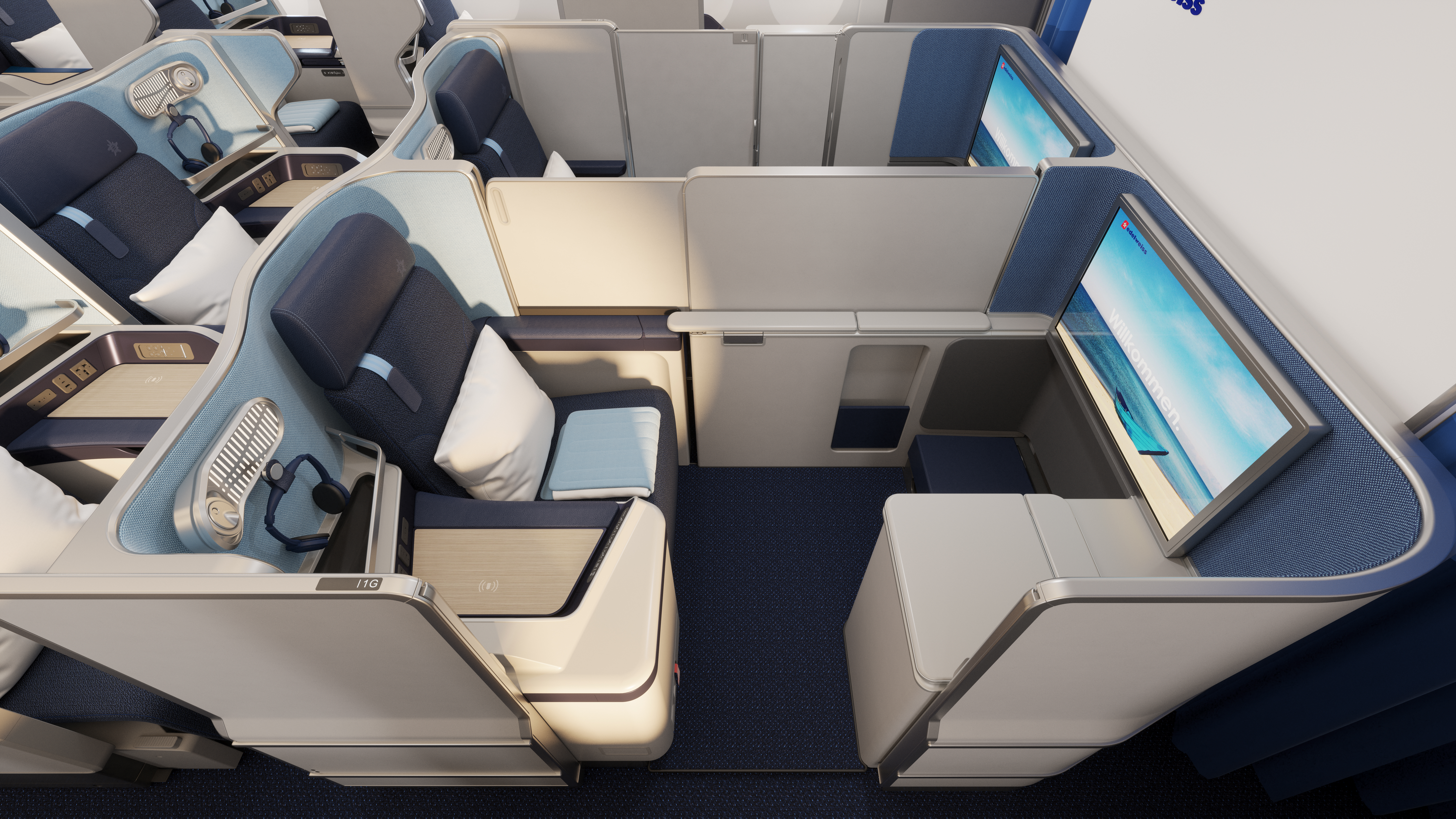
The announcement is not incremental. It’s a full cabin rethink: direct-aisle-access Business Class in a consistent 1-2-1 layout, a “Business Suite” with privacy doors and a 32-inch screen, a new Premium Economy cabin with upgraded service rituals, and a technology stack—Starlink, 4K IFE, Bluetooth audio connectivity, and USB-C power up to 60W—that many network carriers still treat as “future rollouts.”

This is a case study in how product strategy, fleet opportunity, and brand positioning can combine to produce a surprisingly premium outcome—even in a leisure airline.

Context: Edelweiss, SWISS, and the Lufthansa Group “Brand Ladder”

Edelweiss positions itself as Switzerland’s leading leisure travel airline, based at Zurich Airport, and describes itself as a sister company of SWISS and a member of the Lufthansa Group. That “sister-company” relationship is not just corporate structure—it shapes hub expectations and the minimum viable “Swiss quality” bar for long-haul leisure flying out of Zurich.

In practice, Zurich creates a unique pressure: passengers connect, compare, and talk. A holiday airline product that feels materially behind the hub’s premium flagship becomes visible friction—especially when premium leisure travelers increasingly pay for comfort upgrades rather than defaulting to the cheapest fare.

What Edelweiss Announced: A Cabin Designed “Holistically”

Edelweiss framed the A350 cabin as a complete experience redesign under the motto “More room to feel good,” blending calmer aesthetics, premium materials, and a modern onboard tech baseline across all classes. The official release is unusually detailed about both hard product and service cues.

Economy: small changes that matter on long-haul

Edelweiss is adding approximately three centimeters of legroom across Economy seats versus the previous cabin and increasing seat recline angle—minor on paper, meaningful at scale on long flights where comfort degradation is cumulative.

Premium Economy: a real “step-up,” plus service cues that justify price

Edelweiss is introducing a new Premium Economy cabin with 28 seats in a 2-3-2 configuration and roughly one meter of legroom, using a hard-shell seat comparable to those used on other Lufthansa Group airlines.

Commercially, the value proposition is reinforced through “premium cues”: welcome drink before takeoff, expanded food options served on china with a tablecloth, included alcoholic beverages, and noise-canceling headphones.

Business Class: consistent 1-2-1 layout with direct aisle access

The A350 moves Edelweiss Business to a continuous 1-2-1 configuration, giving every passenger direct aisle access and fully flat beds. Edelweiss also keeps a leisure-specific twist: roughly half of the seats are “double seats” designed for couples traveling together.

Business Suite: doors, a 32-inch screen, and a sleep-first design

The headline surprise is the Edelweiss Business Suite: ~1.20m privacy doors, a 32-inch monitor, adjustable divider in the middle suites for companions, a generous open foot area, and upgraded sleep amenities (memory foam pillow + mattress topper).

Technology: Starlink, 4K + Bluetooth, and serious power

Edelweiss bundles a modern tech baseline across all classes: free high-speed internet via Starlink, 4K screens with Bluetooth audio connectivity, 400+ films and series, a 3D flight map and external cameras, and human-centric lighting designed to support circadian rhythm.

It also includes wireless charging (Premium Economy and above) and USB-C/USB-A ports at every seat up to 60W (enough for laptop charging), with additional power outlets in Business and Business Suite.

Why this can feel better than Business Class across much of the Group

Customer perception is shaped less by the “best available seat” and more by the “most common seat people actually fly.” Lufthansa has publicly positioned its next-generation Allegris product as the future baseline, but rollout realities mean fleet experience remains mixed for now. For the official product view, see Lufthansa Allegris Business Class.

Historically, Lufthansa’s long-haul Business Class was widely criticized for older 2-2-2 layouts on parts of the fleet—especially due to the lack of direct aisle access. A representative industry write-up is available here: The Points Guy review.

Against that backdrop, Edelweiss’ A350 proposition is strategically clean: make direct aisle access consistent, add suite-level privacy for those who value it, and modernize tech so the cabin feels current.

What to watch: where the strategy will succeed—or get tested

1) Will customers pay for “Business Suite” as a distinct tier?

The suite concept is a monetization lever: doors, a 32-inch screen, enhanced sleep comfort, and extra storage are tangible. If priced intelligently (not purely as a luxury surcharge), this can drive ancillary revenue while keeping the base Business cabin competitive.

2) Premium Economy: the quiet profit engine

Premium Economy has become one of the most resilient long-haul segments because it captures travelers who self-fund comfort but won’t stretch to Business. Edelweiss’ combination of seat space plus upgraded service rituals is designed to defend the price differential with “felt value.”

3) Operational delivery will define the story

Cabins win headlines, but consistency wins loyalty. Starlink uptime, catering execution, and the real-world wear of premium materials will determine whether the product remains premium at scale. Edelweiss has set expectations high—now it must deliver with leisure-season peaks, high aircraft utilization, and mixed customer profiles.

Timeline: when you can actually fly it

Edelweiss states the first aircraft with the new cabin will enter service in December 2026, with flights bookable from summer 2026. Additional A350s will be converted in waves through January–July 2027, with the full A350 fleet equipped by summer 2027.


Source: Edelweiss Newsroom — “More space to feel good: Edelweiss presents the new cabin in the Airbus A350.” Read here.

France has many famous business dynasties. Few inspire as much admiration, suspicion, and outright jealousy as the Mulliez family.

They built and co-own a constellation of household brands—Decathlon, Leroy Merlin, Auchan, Kiabi, Boulanger, Electro Dépôt, and many more. Yet their model remains intentionally discreet, structured around a family association rather than a single “group,” and powered by internal capital recycling across dozens of operating companies.

In a country where debates about “capitalisme héréditaire” and fairness are constant, the Mulliez ecosystem sits at the center of a paradox: it has created jobs, consumer value, and international champions—while simultaneously becoming a lightning rod for criticism when restructuring hits, dividends rise, or the family’s opacity meets public expectations of transparency.

This article takes a balanced, business-first look at (1) what made the Mulliez model successful, (2) what is currently stressing it, and (3) why the combination of success + discretion + capital concentration so often translates into jealousy—especially in the French context.


1) The Mulliez “galaxy”: not one company, but an ownership system

A key point is structural: the Mulliez are not a classic listed conglomerate. Their ecosystem is held together through the Association Familiale Mulliez (AFM), which groups together members of the family and organizes shared ownership across many businesses.

According to reporting in Le Monde, the AFM includes 950 members and spans around 130 companies, employing more than 620,000 people worldwide, including ~175,000 in France. The same source notes that this scale would make it the largest private employer in France—if it were recognized as a single group.

That “if” matters. Because the Mulliez model rejects the label of a centralized group, preferring a federation of businesses tied by common shareholders—while unions have pushed to have AFM treated as a group to facilitate redeployment obligations during layoffs and restructuring.

Why this matters strategically: the AFM structure is not an administrative detail. It is the core of their competitive advantage… and the core of the controversy when cycles turn.


2) What made the model work: a capital + entrepreneurship flywheel

2.1 A long-term ownership mindset (with a founder logic)

The origin story (as described in the same reporting) is classic “family capitalism”: Louis Mulliez encouraged his children to create and invest in new ventures, meet regularly to share experience, and become shareholders in one another’s businesses—creating a culture of internal entrepreneurship + mutual ownership.

In practical terms, that translates into:

  • Patient capital: no quarterly earnings pressure from public markets.
  • Compounding know-how: retail operations, real estate, logistics, merchandising, pricing, and store execution are learned and reused across banners.
  • Repeatable venture creation: a playbook for launching, scaling, and sometimes shutting down formats.

2.2 The “cash cow rotation” mechanism

The family’s success is not only about picking winners—it is about rotating the cash cow. Historically, one strong business financed the next wave of growth elsewhere.

Le Monde describes how Phildar (yarns) served as a “bas de laine” (cash reserve) for early expansion; then Auchan became a “mère nourricière” supporting Decathlon, Leroy Merlin, Flunch and others.

That model has a brutal elegance:

  • When a banner matures, it generates cash.
  • Cash is redistributed (dividends) and reinvested into other businesses or turnarounds.
  • New banners grow into the next generation of cash engines.

More recently, the same reporting notes that Auchan France represents only ~5% of AFM value, while Adeo (Leroy Merlin and related banners) and Decathlon have become the heavyweights sustaining the system.

2.3 A culture of operational autonomy (“initiative to the field”)

Another differentiator is cultural: decentralization and “store-first” autonomy. AFM leadership argues that empowering teams locally helped them respond quickly during the COVID shock and even gain share versus Amazon in some categories.

Whether one fully buys the claim or not, the underlying management philosophy is consistent: execution at scale, with strong internal promotion and deep retail craft.


3) Why the model is under pressure now: retail physics changed

If the Mulliez story were only about success, nobody would be talking about it this intensely today. The reason it has re-entered public debate is that several prominent banners are facing structural headwinds—and the old playbook is being stress-tested.

3.1 The “overexposure to physical retail” problem

The AFM portfolio is heavily concentrated in physical retail formats—hypermarkets, specialty retail, home improvement, sporting goods, apparel, furniture. That was a superpower during the decades of “hyperconsumption.” It is a vulnerability in a world shaped by:

  • E-commerce scale and platform economics
  • Fast-fashion and ultra-low-cost entrants
  • Customer acquisition shifting to digital
  • Rising operating costs and real estate constraints

The article explicitly references competitive pressure from players such as Amazon, Shein and Temu, and the “decommercialisation” trend impacting roundabouts and city centers.

3.2 High-profile difficulties: Auchan, Alinea, Foundever

Recent headlines have amplified the perception of fragility:

  • Auchan announced plans to transfer nearly 300 French supermarkets under Intermarché/Netto banners—interpreted as an admission of failure after years of losses and market-share erosion, with hypermarket uncertainty still looming.
  • Alinea entered judicial reorganization again, threatening around 1,200 jobs.
  • Foundever (ex-Sitel), employing ~150,000 globally, faced a debt restructuring process in the U.S., described as heavy “surgery.”

These situations are not identical—but they converge into one reputational effect: when a “discreet empire” hits turbulence, the public narrative quickly becomes moralized.

3.3 Governance tradeoffs: loyalty vs turnaround speed

Le Monde also highlights a recurring critique from observers: the family may excel at conquest but struggle in crisis, relying heavily on internally promoted leaders and maintaining confidence “against all odds” longer than outsiders would.

From a transformation perspective, this is a classic governance dilemma:

  • Internal promotion preserves culture, craft, and loyalty.
  • External turnaround talent can accelerate painful decisions and new capabilities.
  • But mixing the two requires a governance maturity that many family systems resist until a crisis forces the issue.

4) So why the jealousy? Four drivers that are uniquely “French”

Jealousy is rarely about the facts alone. It is about what people believe those facts represent—fairness, legitimacy, symbolism, and power.

4.1 The visibility gap: “big enough to shape lives, discreet enough to avoid scrutiny”

The Mulliez are frequently described as living by “pour vivre heureux, vivons cachés.”

That discretion is rational from a family-risk standpoint. But it has a cost: in the public eye, discretion often reads as avoidance—especially when restructuring impacts thousands of employees.

In other words: when you employ massive workforces and shape entire local economies, people expect a level of transparency similar to listed groups, even if the legal structure is different.

4.2 Capital concentration + inheritance in a country sensitive to inequality

France has a long-running cultural tension with hereditary wealth. The Mulliez model is, by design, a mechanism to preserve and compound family capital across generations. Even if it creates economic value, it triggers the perception of an “unfair starting line.”

That perception intensifies when contrasted with ordinary household constraints: wages, taxes, inflation, housing costs. The psychological math is simple: “they win even when the rest of us struggle.”

4.3 Dividends, wages, and the optics of redistribution

Nothing inflames jealousy like a number. Le Monde notes union criticism at Decathlon regarding €1B in dividends (compared with €787M net profit in 2024), while also noting that part of the dividends benefited 60,000 employee shareholders and that AFM injected €400M (2024) and €600M (2025) into Auchan.

From a finance standpoint, this can be framed as internal capital allocation and mutual support. From a public standpoint, it can be framed as “cash out to owners while stores cut costs.” Both framings can be partially true depending on what lens you use.

4.4 The “group or not a group?” tension in social expectations

When unions argue the AFM should be treated as a single group to enable redeployments between sister companies, they are making a broader point: if capital is shared, then social responsibility should be shared too.

This is a deep French expectation: large economic actors are expected to behave as “institutions,” not merely collections of private assets. The AFM model challenges that expectation—and that creates friction.


5) A fairer assessment: why this isn’t just “rich family = bad”

It is easy—especially in polarized narratives—to turn the Mulliez story into a morality play. A more rigorous view recognizes tradeoffs.

5.1 They created real consumer value at scale

Decathlon democratized access to sport. Leroy Merlin and Adeo built household renovation capabilities and accessible DIY distribution. Kiabi pushed affordable family apparel. These aren’t abstract financial constructs: they are practical value propositions used daily by millions.

5.2 They built jobs—and a management pipeline

Retail is often dismissed, yet it remains one of the largest employment engines. The AFM system is also a talent factory: store leadership, logistics, procurement, category management, omnichannel operations. That operational discipline is rare and transferable.

5.3 They accept “creative destruction” internally

The same reporting highlights a Schumpeterian “creation-destruction” process: some formats fail (Pic Pain, Surcouf, etc.), some recover after long struggles, and cash cows rotate.

In plain terms: they don’t pretend every bet will work. They keep funding the system until something else wins.


6) The strategic lesson: the model must evolve (without losing its edge)

The real question is not whether the Mulliez family “deserves” its success. The question is whether a retail-centered ownership system can remain dominant under new market physics.

6.1 Data and ecosystem moves: Valiuz as a signal

One of the most telling evolutions is the move to share customer data across banners to compete on advertising targeting and platform capabilities—formalized via Valiuz (officialized in 2019), after difficult internal negotiations.

This is strategically coherent: retail margins are under pressure; monetizing data, media, and ecosystem services becomes a defensive and offensive lever—if executed well.

6.2 The next governance challenge: the fifth generation

Le Monde notes periodic introspection exercises about where the family wants to be in 20 years, and flags the arrival of the fifth generation as a key upcoming challenge.

Family systems become harder—not easier—over time: more shareholders, more branches, more divergent views on risk, tech, liquidity, and social responsibility. Sustaining performance requires stronger governance, not just stronger operators.


Conclusion: admiration and jealousy can be two sides of the same coin

The Mulliez ecosystem is a case study in how to build durable economic power: patient capital, decentralized entrepreneurship, operational excellence, and internal reallocation of cash between banners.

But the same ingredients also generate backlash in France: discretion collides with social expectations; dividends collide with wage debates; “not a group” collides with workforce redeployment demands; inherited ownership collides with cultural sensitivity to inequality.

In the end, the jealousy is not only about wealth. It’s about perceived legitimacy—and legitimacy is earned not just by performance, but by transparency, social reciprocity, and the ability to show that success scales benefits beyond shareholders.

Question for leaders and policymakers: As retail transforms and restructurings continue, should systems like AFM be encouraged as long-term value builders—or regulated as de facto groups with broader obligations? The answer will define not only the Mulliez trajectory, but the future shape of French capitalism.

When Brand Standards Collide with Franchise Autonomy: Lessons from Hilton’s Minneapolis Controversy

On January 6, 2026, Hilton Worldwide Holdings made headlines when it removed a Hampton Inn franchise near Minneapolis from its reservation system after the property allegedly refused to honor room reservations made for Immigration and Customs Enforcement (ICE) agents. Hilton stated that the hotel’s actions were inconsistent with its brand values and standards, emphasizing that the property was independently owned and operated.

Beyond the political reactions the story triggered, this episode exposes a structural challenge in the hospitality industry: how global brands enforce standards across franchised properties while preserving franchisee autonomy.

Continue reading “When Brand Standards Collide with Franchise Autonomy: Lessons from Hilton’s Minneapolis Controversy”